


Cork tree bark, giving bronze/pink. Cotton and silk fibre showing completely different colours though both were in the same dyepot!

Dwell on roses till times turn more sane.


 This is one of the pots, an 'Ali Baba' type of pot, very suitable for growing plants in but unfortunately it has no hole in the bottom for drainage but is a good collector of rain water!
 A rather beautiful bowl used for the paste, though its first use is for the grinding of minerals.

 A patch of stitchwort
 This house which we passed yesterday, never ceases to amaze me, the pink paintwork echoing the colour of the great pink horse chestnuts tree.
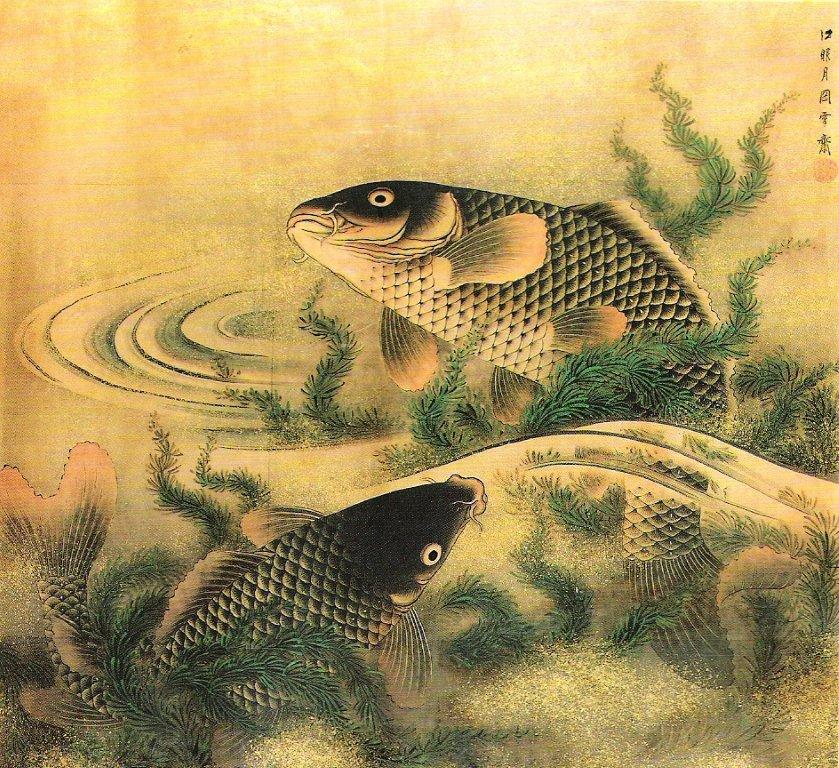 Two carp leaping among waves Tsukioka Shuei (1790-1830)
The picture above which hangs on a wall, was originally a single screen surrounded by a frame and free-standing. Such screens were set in direct alignment with the entrance to a temple. So that as you went into the temple it faced you. This was to keep the bad spirits out, because apparently they only travelled in a straight line, not like our spirits at the cross-roads who could presumably take whatever road they felt like, though of course the answer that by burying the wicked at a cross road they would be confused as to which way to go.
 Tamamushi Shrine;
 |
| Giving one self to the hungry tiger |

 This is the 7th century depiction of the story of the prince offering himself to the lioness. It is a 'three picture' narrative. The picture is depicted on the side of a portable altar in the Horyu Ji temple
p.s. this of course leads on to 'deep ecology', and the writing of Arne Naess and others, a philosophy underpinning a lot of green radical thinking....
some of the principles set out by this philosophy..........
The well-being and flourishing of human and nonhuman life on Earth have value in themselves (synonyms: intrinsic value, inherent value). These values are independent of the usefulness of the nonhuman world for human purposes.
Richness and diversity of life forms contribute to the realization of these values and are also values in themselves.
Humans have no right to reduce this richness and diversity except to satisfy vital human needs.
The flourishing of human life and cultures is compatible with a substantial decrease of the human population. The flourishing of nonhuman life requires such a decrease.
Present human interference with the nonhuman world is excessive, and the situation is rapidly worsening.
Policies must therefore be changed. These policies affect basic economic, technological, and ideological structures. The resulting state of affairs will be deeply different from the present.
The ideological change is mainly that of appreciating life quality (dwelling in situations of inherent value) rather than adhering to an increasingly higher standard of living. There will be a profound awareness of the difference between big and great.
Those who subscribe to the foregoing points have an obligation directly or indirectly to try to implement the necessary changes.
http://www.youtube.com/watch?v=llvnEaLUOac
These are fine words but probably impossible to achieve, I do not necessarily criticise Naess but having read all these authors over the years I think that there is a certain unrealistic aim here, though beautifully put. Naess lived in Norway, he loved the mountains and solitary places, most of humanity live in a very different scenario. But all these philosophies have come and gone, his was the inspiration for movements like 'Earth First' an American group more radical than Greenpeace.
Today I find in my email box George Monbiot talking about another movement, this time 'The Dark Mountain project' proposing that all of the above, the individual campaigns and trying to save the world are a waste of time! What we should be doing is knuckling down and learning to survive whatever happens in the future - not terribly new thinking, its part of the myth that 'greens' live by, but perhaps its a sensible way forward. And do I note in the writing that Paul Kingsnorth has also been reading Mary Midgeley, and putting forward the similar idea of creating a new myth by which we live, and thereby living it?


 Poster from 'Save Me' Brian May's campaign
 The River Chelmer
 Fungus along the River Chelmer
 Blakes Wood and wood anemones
 tiny violets

 Creative Commons - Andreas Tille
continuing........
 And this is the picture that haunts me, the rows of houses on the other side, above this town will be the desolate moors, but huddled by the sea, this is the place where boats for centuries have sailed in, mostly with their catches from the sea but sometimes the great dragon ships of the vikings as well.........
But by reading the many names this town has had over the centuries there is a feeling of an 'alien' culture. All the small villages around the town and up on the moors have a strange ring to a southern ear, for we are now in the land where Scandinavian victory coloured the landscape.
Sleights is Old Norse, sletta 'flat land' with an English plural, like the Norman place name Eslettes.

 sea fret = mist


 This must be the south door
 Tournai Font; "The Lincoln font is typical of its type and consists of a large square bowl on four colonnettes with a heavy central drum support and a massive carved base to suit. The bowl has been split horizontally in antiquity and has been skilfully repaired. The top of the bowl has been carved with leaves and rosettes whilst each side of the bowl is carved with grotesques and lions with foliate tails, possibly to represent the original sin which baptism removes."
 elaborate ziz-zag Norman door, 'barley twist' pillars as well
 The elaborate arcading
 Towers
The cathedral and town stands on the only long ridge for miles, its tall towers can be seen from 35 miles away. The town itself is walled, and has several picturesque streets and medieval buildings round the cathedral. The font is hideous, apparently there was a fashion for imitating black marble, so a dark igneous limestone was used then buffed and polished to represent marble.


 The photos show a lovely sunny day, but not the cold wind that whipped across the moor, and I also took of a photo of a large black/white bird that suddenly rose from the heather (no not a magpie!) but it seems to have flown the photo....


