Tuesday, September 8, 2015

News time

broke that in the region of Durrington Walls, the supposed 'living' area of the Stonehenge landscape, there are buried 90 large megaliths in a slightly half moon shape under the bank.  Not new news,  this had been noted in 2011, and one wonders if there is something else lying underneath this appearance of a new archaeological wonder the archaeologists wanted to highlight.  When I say living area I mean the place where the people lived,  the area around Stonehenge stone circle is considered the place of the dead. 

There are arbitrary theories, made by different archaeologists, and may have relevance or may not, each theory comes backed by a book but there is never a whole answer.... so a timely poem for this 'great discovery' which is after all just another piece in the jigsaw that is the Stonehenge Landscape project,


                                                  A Game of Henge - Stonehenge

Phillip Gross

A game of Henge, my masters?
The pieces are set. We lost the box
with instructions years ago.

Do you see Hangman? Or
Clock Patience? Building bricks
the gods grew out of? Dominoes?

It's your move. You're in the ring
of the hills, of the stones, of the walls
of your skull. You want to go?

You want out? Good - that's
the game. Whichever way you turn
are doors. Choose. Step through, so...

And whichever world you stumble into
will be different from all the others, only
what they might have been,
you'll never know.
--------------

Saturday, September 5, 2015

Friday outings.


Where to start? Perhaps the 'fretting' weather as we approached the moors, fine misty rain and dark clouds gathering over the moors.  You climb up to the moors from the farm lands below, once marshy places full of water, today prime farm land, and then you hit the great dark landscape of pine and larch trees, forestry plantations, dark and forbidding, edged with bracken and heather. A wilderness of cultivated trees, as you pass along the old moor road, old stone gateposts tell you that once even this land was farmed right to the edge of the moor.

We stopped and I gathered some heather, and then drove down to the Wheeldale Beck, no one was there this time, so I walked along by the water, it was raining slightly so LS stayed in the car.  Sheep on either side, did not bother to move as I passed by, the water peat stained brown, rippling along. No mushrooms yet where the trees start, only the ground soaked by rain, puddling everywhere.  I took Moss in my mind along on this walk, a spiritual creature, who took no notice of the sheep or the water, he hated getting wet.

We came to Lastingham, which I have written about before, for lunch at The Blacksmith Inn.  A typical old world pub, tankards hang from the beams above your head, you are respectfully asked to remove muddy boots at the door.  Here you can order great pies, fish and chips, and a whole host of different meals.  We took the easy way out and ordered, me a ploughman and LS a ham sandwich, not exactly an anniversary meal, but we cannot do large meals at lunch time.  The small corner table in this pub is always 'reserved' I think for a single oldish man who we have seen there a couple of times, but he wasn't in today, perhaps it is reserved for a ghost from the past, a place by the fire with all the copper kettles and pans gleaming in the firelight.  The landlord always sits on a stool by the bar, not doing much.


Friday, September 4, 2015

Wild Geese by Mary Oliver


M.C.Escher - Day and Night


You do not have to be good.
You do not have to walk on your knees
for a hundred miles through the desert repenting.
You only have to let the soft animal of your body
love what it loves.
Tell me about despair, yours, and I will tell you mine.
Meanwhile the world goes on.
Meanwhile the sun and the clear pebbles of the rain
are moving across the landscapes,
over the prairies and the deep trees,
the mountains and the rivers.
Meanwhile the wild geese, high in the clean blue air,
are heading home again.
Whoever you are, no matter how lonely,
the world offers itself to your imagination,
calls to you like the wild geese, harsh and exciting -
over and over announcing your place
in the family of things.


Two things chosen today, Mary Oliver's Wild Geese, reminds me that the swallows are returning south soon, and leaving these wintry shores and the comfort of the old church, just like the wild geese in Kerraldune's blog in Canada.
The Escher drawing, reminds me of this as well, and the contradictory nature of humans as we go to and fro in our daily lives.  I am sure there is a dissertation out there on the drawing, does it matter? can it not just be seen for its visual message.
We are to go out for an anniversary lunch today soon to Lastingham, and maybe a walk by the beck, the weather is cold, why has Autumn dropped by so quickly?

Thursday, September 3, 2015

Mino's

Lewis Chess men
British Museum

News in general, there is an impressive story about how the Lewis Chess Men could have been carved by a woman, as  female artwork is so sparse in the medieval period, there is a certain satisfaction thinking that someone who carved these expressive little figurines could have been female!

These stolid, expressive little figurines are star draws in the museums that possess them. Ms Brown aptly calls them “Norse netsuke” (after the little Japanese carvings), shaped with skill and whimsy from what the Icelandic sagas term “fish teeth”: the queens, one hand pressed in alarm or woe to a cheek; the grim kings with braided hair, thrones elaborately detailed with Romanesque loops; the doughty, somewhat ludicrous knights; mitred bishops; and most of all the rooks, several biting their shields, unmistakably representations of Viking “berserks”, the warriors of the Norse god Odin.

Today we have put boxes up into the loft, or what my son-in-law calls, 'Spider City' due to the large dead spiders that occupy this space, the boxes went up mostly empty, but two were full, so we looked at the 'straw' box contents.  Here you will find the 'straw rain coats' or minos worn by Japanese farmers maybe, snow shoes and straw boots.  Strange that people wherever they are in the world always use the materials to hand, and apparently straw does work as the rain runs off the straight stalks.  I wonder if the 'Yeti' myth started from here!

The back

Front


Very scratchy to wear I would have thought, the boots and snow shoes are just as strange.....

boots and a second straw coat

snow shoes


Some links

Whilst we watch the sad unfolding of an enormous migration to Europe and wonder what to do, there are basic things we can do, send money to non-governmental bodies, nag our politicians to do more, discuss the situation rationally amongst the people we know.  The Independent has some of the answers.  Icelandic people have voted above their prime minister, who only wanted to help 50 displaced people, but 11,000 Icelandic people have offered to house some of the refugees.
So we watch, and wonder how it will all play out, as thousands of people flock to Europe for sanctuary, will Cameron at least soften his hard line approach?  Will an influx of a different religious group to a basically Christian/Secular Europe, have an unexpected, maybe even a catastrophic effect on socially peaceful groups?  There are so many questions and so many people to house and feed.....

Germany - Munich Railway station;


Wednesday, September 2, 2015

Wednesday


If you look at the window closely, you will see the imprint of a bird, LS reckons it is an owl, I think maybe one of the clumsy wood pigeons that lollop around in the garden.  Span of wings either side and the breast feathers in the centre - poor creature.
This morning has been looking for duvet covers on the internet to match the bedroom curtains colour, I fancy Indian material but everything is pricey, all comes down to the fact that LS wants a warm colour, and I have always loved the ochre base which results in warm red/browns and yellows of Indian fabric.
Our swallows are still with us though Bovey Belle's in Wales have flown to warmer climes, so the next season is on its way.  The workmen have erected scaffolding against the church to take down drainpipes, they haven't touched where the swallows nest yet as they are still going in and out.
The hens as regular as ever, produce three eggs a day between them, and I worry about using them all up.  Scotch eggs, madeira cake, scrambled eggs each morning, I have never had so many eggs.   Omelettes of course, with chips.  Ever since I bought that fryer three weeks ago LS has made chips, he is over the moon with the fryer, yesterday we had tempura of various vegetables;  he likes to cook Japanese, which can be either noodle or rice based, though the ingredients are difficult to find out here and it looks like he needs to order over the internet from London.
One of his old friends is a saki wine distributor, he lives in Hawaii, but every year comes over to London to sell his saki to the restaurants, he should be coming up to us in December, that is of course if the weather here in Yorkshire isn't impassable with snow.
We are also to have a small Japanese garden down the side of the house, it is very overcast dull (no sun) and will welcome ferns, though how to get moss to grow is another thing.

Monday, August 31, 2015

Kirkdale grave yard - facing East


The photos that did not appear in the blog below, every stone facing into the deep, dark wood, and of course the Hodge Beck that must run through it.

A glimpse of 'eternity'!

The old venerable tree that greets you at the gate

Falling 'dangerous' gravestones. Perhaps these are our Georgian ancestors.  I found someone who was a 101 years old though.

Just by the church a 'prehistoric' stone perhaps?

Sectioned off, this is I think a war remembrance part.  Note the belt on the cross.

No acknowledgements on 10 of the similar graves, all just planted with I think perennial geraniums.

4 sheep are meant to keep the grave yard clear, not doing a particularly good job

A tangle of roots?

St.Gregory's Minster church at Kirkdale


I had been reading about the history of this part of Yorkshire  all morning yesterday and this church at Kirkdale had cropped up.  Situated between Helmsley and Kirkbymoorside, half a mile of the main road we visited it in the afternoon.  Set at the end of a lane, no houses around but surrounded by thick woods, it stands a place of peace and quiet.  It had quite a large cemetery around it, which gave it a slightly Gothic character.  Dedicated to St.Gregory it would have been a Saxon Minster, serving several parishes in the district 'was where the old, ruined, minster church had stood in days gone by, the ruined church whose cemetery was still used by the local people for the burial of their dead.'
The cemetery is still used today, there is a little war cemetery as well, fenced of, but eloquent in its setting.


In the walls of the old rebuilt church are the gravestone (These are gravestones of Anglo-Scandinavian design introduced to northern and eastern England by the Danes and Norwegians who settled here in the late ninth and early tenth centuries).  of the Anglo-Scandinavians that were buried at a later date, apart from the Saxon knot work above which can be found in the east wall, these large stone crosses lie in the south facing wall, there is a further one on the west wall......


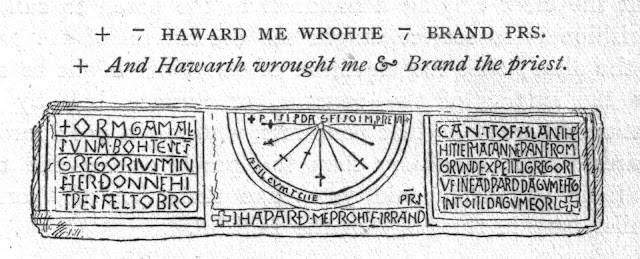
What survives of Orm's church in the existing visible fabric appears to be the south, west, and what remains of the east walls of the nave; That quote of course needs some explaining, for in the front porch there is a sun dial, which gives fascinating detail of when the dial was made, its history can be found here and an interpretation of the words.  The sun dial sits above the church doorway,


What would we do without our Victorian ancestors who copied and wrote down everything in their everlasting curiosity about everything historic... the words are analysed in the link above.


To quote;  Short though it is, this inscription provides us with a surprising amount of information. Most important of all, it enables us to date the earliest phase of the existing fabric with some precision. Tostig, the son of Earl Godwin of Wessex and the brother of Harold II the last Anglo-Saxon king of England, was earl of Northumbria from 1055 to 1065. It was therefore during that decade that Orm the son of Gamel rebuilt St. Gregory's church, It is very rarely that we can date the construction of an early medieval church so precisely.  So there is even a date for this part of history, a rare and valuable truth.


Inside the church two finely decorated coffin slabs of an earlier date;


http://www.ascorpus.ac.uk/catvol3.php?pageNum_urls=58&totalRows_urls=288


To quote on these tomb slabs;  Expert scholarly opinion would date these to the Anglian or pre-Scandinavian period (i.e. before c.870): one of them appears to be of the eighth century and the other of the ninth. On the strength of this dating the history of the church on this site may be caned back to c.750, conceivably even earlier. For their day they are very handsome pieces which display craftsmanship of a high order. Furthermore, certain features of their design strongly suggest that they originally stood inside a church, These indications show that the persons once buried beneath them were of great status and prestige. The church, which originally housed these tombs, may well have been an imposing one.    I suspect the stone 'tasselling' on the edge makes these tomb stones something to be found inside the church, and out of the weather.

Saxon quoins below.....

Saturday, August 29, 2015

Outings

The gardens in derelict state in 1990s


Helmsley Walled Garden History


It is hard to imagine the former state of the above garden, but it was this lady Alison Ticehurst who started the restoration we see today, turning a derelict market garden venture into a beautiful and productive garden from the 1990's.  There are many apple trees in the lower part of the garden, old Yorkshire names and old varieties jostle against each other, the apples are very prolific, no one has thinned them in the early part of summer, and they cluster like bunches of berries on the trees.
It seems a communal act of dedication to run the gardens, there is a small staff supplemented by volunteers.  The cafe has delicious looking cakes, we only sampled the scone and homemade jam, as did a few passing wasps, but insect life, especially bees are prolific in the garden.
Garden produce is sold, as are plants by the cafe, they go to an important part of the aims of the garden which is to use them for horticultural therapy of people dispossessed of life's bounty, in other words people who are miserable....


This is Alison Ticehurst garden's created by her mother. Alison died in 1999, five years after starting the project


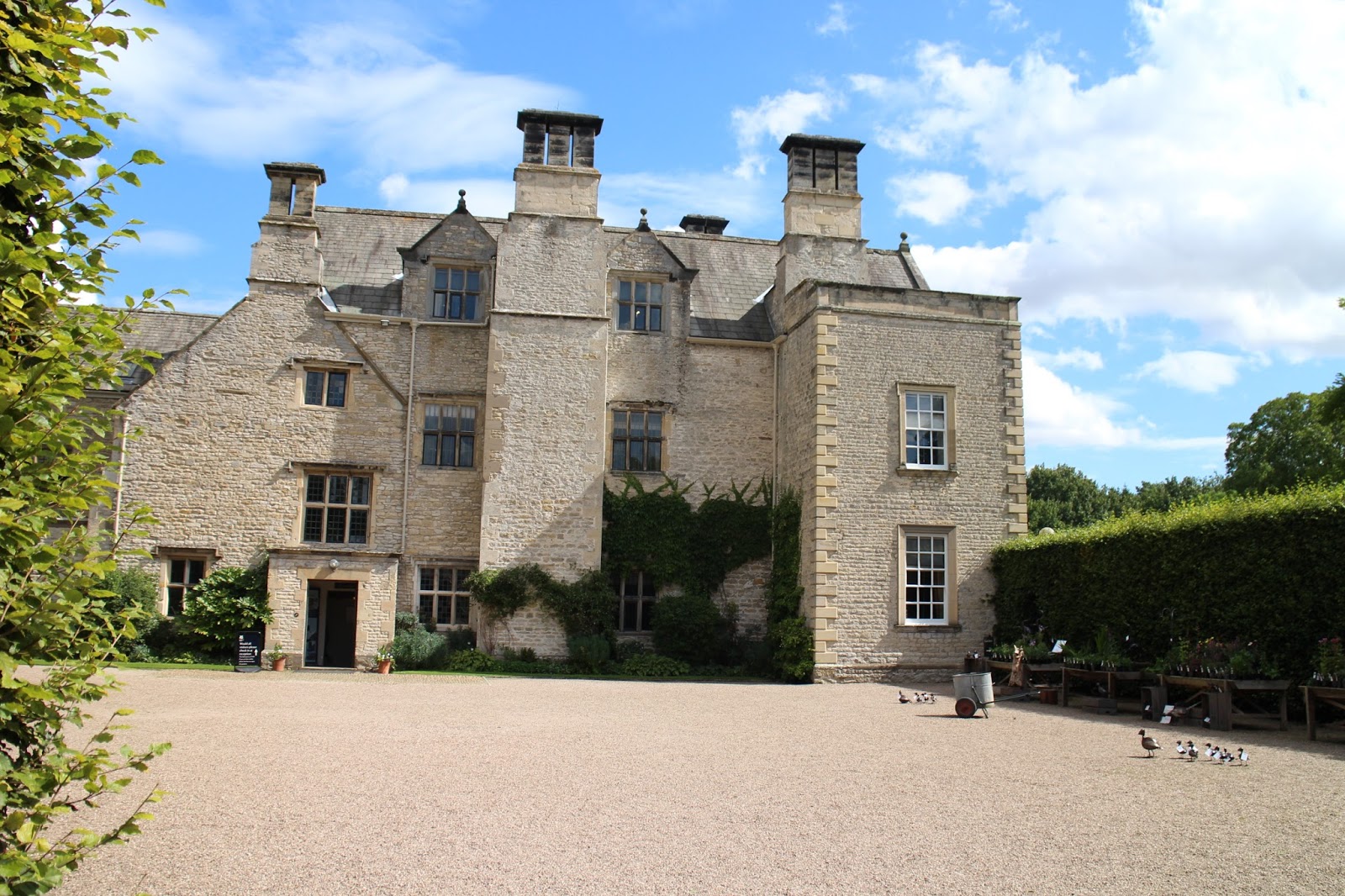
After the gardens we went in search of Nunnington Hall, LS had followed a route (on Google) and swore we could get to it through the country lanes.  We did not. But arrived eventually, not going in, another day out, but it is very imposing, set by the river.


Friday, August 28, 2015

Just photos -Helmsley Walled Garden


Luscious flowers in the orchid house, no orchids though

coleus foliage plants


Flowerbeds and walls