Tuesday, July 26, 2011

Porthgain and Abereiddi

Abereiddi Blue lagoon, the original slate quarry, the entrance of which was blown up to let the sea in


I have already written about Porthgain and Abereiddi which are roughly a mile apart, so there is not much to add, the first thing you notice about the photos is how bleak this part of the coast is, the stone and slate  that has been hewn away in the quarries tells of back breaking work and what is left now at Abereiddi are the slate houses slowly crumbling away, the round powder house, a safe place for the dynamite to be kept and of course the manager's house set slightly apart higher up the hill.
Today the blue lagoon is used for fun, scuba diving and jumping off rocks, which seemed rather dangerous for the youngsters taking part but they wore hard hats as they swam from rock to rock and then jumped spreadeagled into the deep waters.


Porthgain  stone quarry

Porthgain 'street' the end two cottages belong to an artist and every year that I have been there is an enormous Pyreanean Mountain dog asleep outside.


http://northstoke.blogspot.com/2007/10/porthgain-and-abereiddi-quarries.html

Sunday, July 24, 2011

Warriors Dyke - St.Davids Head


Warriors Dyke
Warriors Dyke is a promontory fort, ie it is a small defended settlement built on a long jutting out rock from the mainland.  Both Porth y Rhaw and the above fort are Iron Age, though they could probably have been earlier.  I read somewhere that if you did'nt find a promontory fort every half mile along the Pembrokeshire coastline something must be wrong.

Warriors Dyke was named by Sabine Baring Gould a vicar of the 19th Century, who also wrote hymns, beside  books on antiquities, mostly of Europe.  He excavated here and found the usual bits of pottery, charcoal and faience beads, plus to my joy, spinning whorls.  Sadly any 19th C excavation messes up the site so that any future more valuable excavation has all the evidence destroyed.
Getting there involves a walk from the popular Whitesand beach, up the side of the cliffs and through the gate onto the moor.  You will be faced with a shallow valley to cross with a stream running through it.
To your right is Carn Llidi with its double cromlech, which we did'nt visit this year; the tomb is hidden, or huddles, against the rock face and in front of it is an old WW2 platform, it takes some finding.
But to return to the settlement, fort is not quite the right word, over in the distance on St.Davids Head you will see another cromlech this is Coetan Arthur, again hidden in a jumble of rocks, but its capstone stands clearly against the sky. Coetan Arthur is framed between two outcrops, the westward is the settlement, and you can find it either by taking the path that goes along the cliff edge, or by heading for the outcrops and walking along the top - a much safer option.

Coetan Arthur cromlech

Warriors Dyke -hut stone circle

another one

I photographed five but they are all very similar.

The settlement is defended by three banks of stones, two very small, whilst the inner one is massive, and tumbles down in a dramatic manner.  Go inside and you will find a small grassy enclosure covered in stones.  There are six stone hut circles here, we found five, the stones haphazardly arranged in circles, presumably the huts would have been thatched with the reeds you find in the boggy marsh valley, but trees around the coast are usually non-existent due to storms, only gorse and heather survive the weather and quite a few wild flowers of course. Sabine Gould says the huts were co-joined but in will need another trip to confirm this!


wood sage

Toadflax lots of it around


Devil's bit scabious

Saturday, July 23, 2011

Porth-Y- Rhaw promontory fort.

Porth-y-Rhaw cove 

Stopping at Nine Wells just outside of Upper Solva, park in the little NT car park, admire the wells on the right, and then take the path down to the sea on  the left.  It traces a watery way through lichen covered hawthorns, so twisted and bent it is as if time stood still. Old trees lie fallen to your left whilst on the right of the path, the cliff/hill stretches upward.  You come to a gate, and a small cove is some distance in front of you. The path meanders down to the sea, there are still reminders of an old medieval mill, stones glimpsed through the meadowsweet flowers that inhabit the marshy ground, the pond for the mill stands higher up.

marshy ground


Taking the coast path to the left and you are immediately confronted with Porth-y-Rhaw promontory fort the defensive banks falling down to the path. Middle Iron Age, there was a small excavation in 1999, and 8 roundhouses were uncovered on the tip of the promontory, the following explanation shows how they were arranged.


The promontory fort


Unknown flowers

Solva

Solva Harbour

Four days, and a host of memories.  Lower  Solva is my spiritual home, to which I return nearly every year.  Its the sheer calmness that appeals, hardly changing, cottages locked in by tall cliffs, and the harbour with its boats riding the endless green of the sea. Tiny fish swim in the shallow lapping waves, the duck with her young losing several daily to the predations of the seagulls.  Crab and lobster advertised everywhere from bungalow to cottage, I even caught a tiny one, no bigger than my thumbnail as I went shell picking.
A Welsh rug from Middle Mill bought plus some alpaca fleece for spinning, the alpacas live along the lane below, my 200 grams comes from Tiffany.

The lane to Middle Mill

We did a helluva lot, Aberridy, Porthgain, St.Davids Head and the Prescelis, (and of course seeing Jennie though not for very long sadly as we had to drive a  long way back) the weather quite often dull, but we seemed to miss the showers.  It has given my photos a slightly grey dull edge, quarries were photographed, the beautiful brown-creamy coloured stone that you see in the cottages, and then there is the great deserted quarry of Porthgain grey coloured and used for roads and brickmaking, and the more dramatic dark  slate quarry of Aberridy.  Industries long gone in the early 20th century, hope and aspiration built on the blood and sweat of underpaid labourers; sloops that sailed in, loaded their heavy cargoes and then sailed to Bristol and London.  All gone leaving behind an industrial wasteland being overgrown by the wildflowers and mosses, so that in a couple of hundred years there will be nothing left but the great brick shutes that are built against the cliff at Porthgain.
On St.Davids Head we saw Coetan Arthur megalithic tomb, plus the Bronze Age promontory fort Warriors Dyke with its 6 stone huts.  Prescelis was Gors Fawr stone circle, plus an exhausting climb up Foel Drygarn, to to see the three great stone Bronze Age cairns, plus of course the view to Carn Meyn, the source, or so it is said, of the bluestones of Stonehenge, and I also noted the position of Carn Alw, which is supposedly a chevaux de frise - defended by upright stones along the entrance, could have been an iron age holding pen for horses and cattle... somewhere I want to go, but it was quite a walk.
Each monument will be gone into detail eventually as I always get muddled with all the various Welsh names.


Friday, July 15, 2011

keeping up;

(Actually now I come to think of it, this morning the obstreperous tones of  John Humphries and the more gentler speech of Evan Davies did not greet my ears at 6 , thought that the Murdoch regime had spiked the BBC, but no, it was strike action by BBC staff, probably to do with pensions and pay, but of course that is a continuing saga across the country....)

Friday, not much has happened this week apart from the great scandal, Murdoch and company.  Politicians have been falling over themselves to denounce the terrible three, mmmm were these the same people who wined and dined with them all these years, fawning at the feet of the great media tyrant ..  Rebeckah Brookes and James Murdoch, plus Rupert are to give testimony at the hearing which is a bit of a surprise but fleeing the country is not really on I suppose, especially as more hacking is appearing in America.  As more scandals emerge daily, I suspect the notorious three will distance themselves away but the empire seems 'broke' at the moment - hurrah. Now for the debt crisis which lurks like a pike underwater waiting to rise to the surface, how can countries owe so much money?
Packing for going away to Wales, the house is scented right through with the smell of lilies, it must float through the windows. Containers for as many plants as possible so they will remain watered. The weather changes each day, more rain now but it is still very dry. And a couple of photos of my grandchildren who obviously love living by the sea.....


Lillie as cheeky as ever, and Matilda scarred by a badly aimed tennis racket but still dragging her Ugg boots around in summer!

Wednesday, July 13, 2011

lilies


Scented lilies, exotic, its colouring luring loads of hoverflies, that seem to get drunk on its scent and pollen.

Sunday, July 10, 2011

The Chelmer

the river curving its way down to the sea

Hemp Agrimony; Grigson says of this plant that it lines the highways and byways of England and is a nondescript flower, but I love it for the buzz of bees, hoverflies and butterflies it attracts, had loads in the old garden.

a family of five young swans


Common mallow; 'common wayside plant', according to Grigson, the children preferred the disks of  nutlets or 'cheeses' in his time to eat. He likens it to monkey-nuts, but the roots were more used for poultices and soothing ointments.


The burdock plant- anyone who remembers dandelion and burdock pop of their childhood, will recognise the name.
Apparently around since 1265
 

purple loosestrife

The working lock

Eager anticipation but rather worried children as they begin to sink

Going down

Through the gates

Saturday, July 9, 2011

Red Geraniums and chateaux

Chateau de Chillon


Yesterday I received an email from my son-in-law with the itinerary for their trip to Switzerland in August, just under a 1000 miles from Whitby to Vevey.  It will be a great experience for the children, travelling through France and they all have their passports ready.  Switzerland is a lovely country, steep sided mountains whose grassy meadows are grazed by large beige coloured cows in summer, their bells clonking away.  When I was there they used to bring the beasts down from the summer grazing through the villages decorated with flowers.  All of this  reminded me of my late father-in-law's excruciatingly bad poem he wrote, as he names the villages and towns, I remember drives he took with my daughter and myself up into the mountains for afternoon tea, the fillet de perche restaurant down by the lake, (a upmarket fish and chips) and the lake itself, often so calm but when storms arose (and they came quickly over the mountains) it would become quite dangerous, and the ferry boat across the lake to France would not be able to land its passengers.  
He and my mother-in-law  had lost their youngest son, and I a young husband, and the ties between my daughter and my sister-in-laws has always been very strong.  So the children when they arrive will be able to follow my daughter's childhood; travel in the little train up into the mountain, passing Leni's small chalet with its pretty garden in Blonay just under the chateau there.  Leni is long dead, though she lived to a venerable old age, and sparred, mostly over bridge, with my mother-in- law Lotta.
Con worked for Unesco for most of his working life, it took the family to many places, but they retired in Blonay, to Lotta's house eventually. So to the poem, Territet just by Montreux had the English church where Con was a church warden, the vicar would often come to Sunday lunch and to be plagued by the ridiculous tricks Marc (Karen's cousin) and Con played on him, false cakes, false poops and jumping mustard pots are the ones I can remember, the vicar strangely enough got quite cross, but you can see Con's very 'englishness' in the way he writes, Lotta on the other hand was Dutch, and very precise in running her household.  There should be a poem by Byron on the Chateau de Chillon, ther is a little island opposite which if I remember rightly was given to Queen Victoria, so is English territory...

The Tourist's Lament by C.J.Opper

A rainy evening in Vevey,
Fills me with intense dismay,
The faded splendours of Montreux
Leave me feeling rather blue;
And if we must stick to verity,
I don't go overboard on Territet.
And, I must say,
Whoever got hooked on La Tour de Peilz?
For Corsier, Blonay, Chebres and Corseaux,
I'm unequally unmoved or even more so;
If there's a place I'd rather not be on
Its the top of the tower of the Chateau de Chillon.
In Southend they would'nt have the cheek to serve,
That cupper tea we got at Villeneuve
We got fish and chips just beside the church
But you have to ask for fillet de perche.
So..... you just ask your mother why we're here,
When we might have been on Wigan Pier.

Monday, July 4, 2011

Hylands House


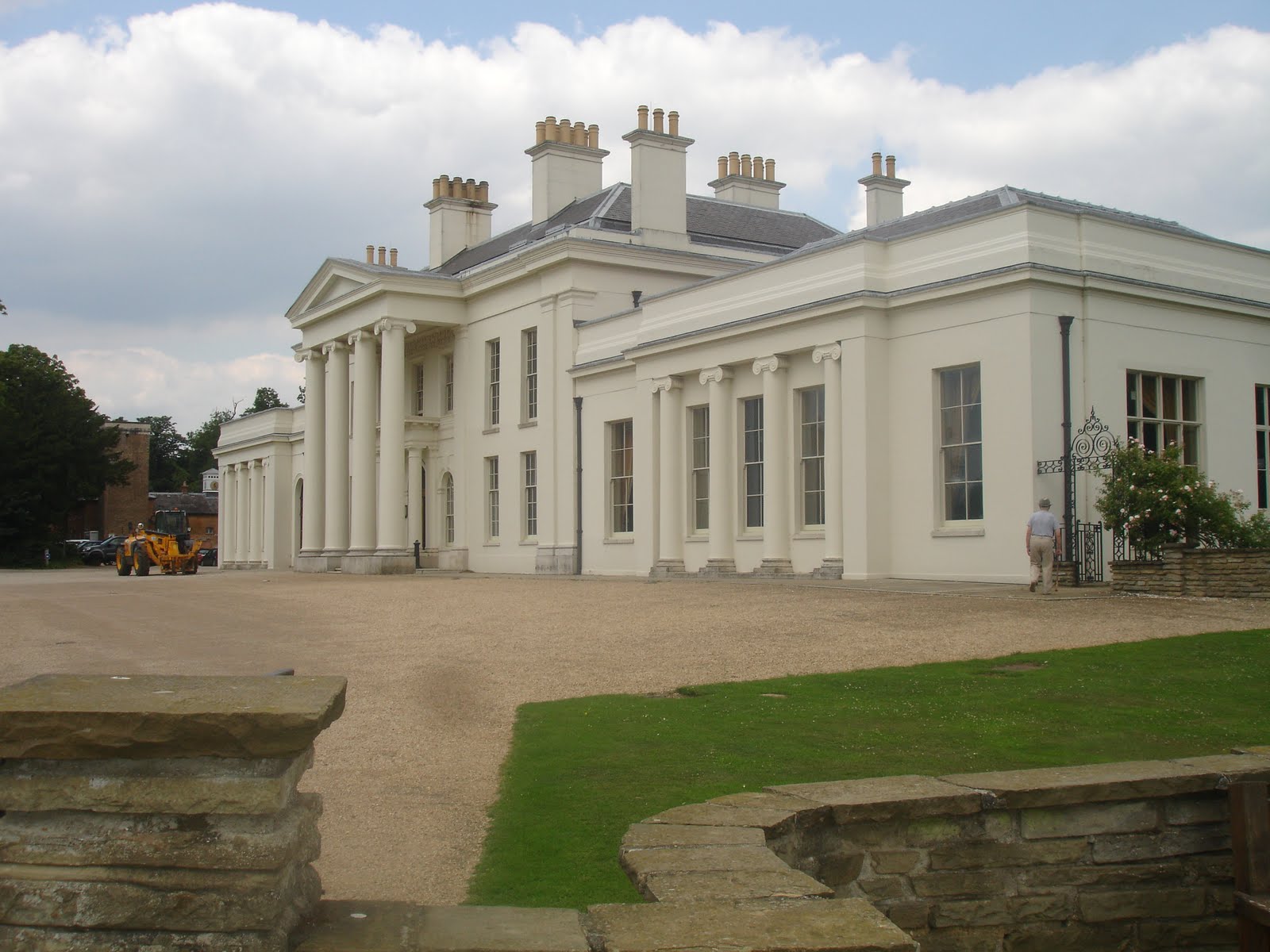
Hyland House fell into disuse in the 1950's and was at one time to be pulled down and the grounds turned into a golf course. Luckily there was enough protest later on for it to be saved, and with the help of lottery money has been restored. So instead of being a place for a handful of people to chase a little white ball around, it has become a place for the public to enter freely, walk their dogs, children, picnic under the trees and generally a place of leisure. Stable block has a restaurant, full of people eating out in the courtyard, with their dogs parked safely under the tables and a secondhand book shop. Plus of course 'events' we went for the craft fair, but really there was only people selling food.
Humprhy Repton drew up the plans for the landscape garden in the 18th century, he did'nt actually undertake any work just handed out one of his little 'red books' with sketches inside. But was the first person to use the term landscape gardener, and he followed on in the footsteps of Capability Brown.

Humphry Repton landscape

We emerged out of the woods to be confronted by these lines of conifers with a rounded mound at the end

Pretty colouring once more on the mound


Front view of the house, just at the bottom of the photo the 'ha-ha' ditch round the garden still exists


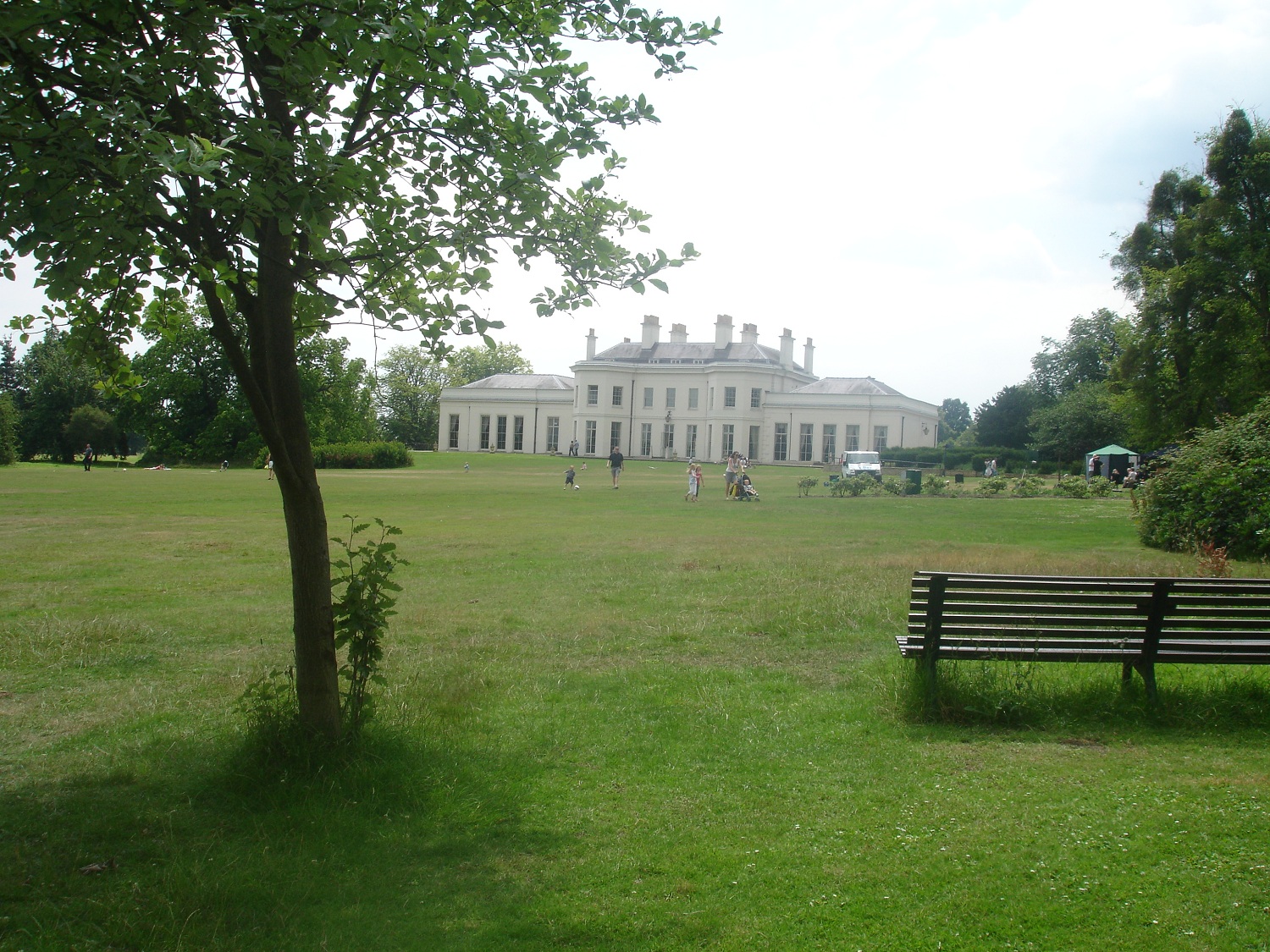
back view of the house
Gardens as we know them don't really exist around the house, the front to have a grand drive with a sweeping front gravelled area for the carriages to stand and turn, the back steps down to the garden below which was well away from the house and had a 'lake', rather small, as the showpiece.  I loved the colouring in the mounded centre but the other beds round the circular lawn were very plain.


http://en.wikipedia.org/wiki/Humphry_Repton

Sunday, July 3, 2011

One World Garden - Hyland House

This garden was created a few years iago, the colouring is soft - greys pink ,whites and a lot of gentle lilac and purple colours.
The hand built walling that leads you into the round small spaces of the garden has no mortar, just grey colouring with the occasional brown in the stone. Tranquility must be the theme and peace of course, it was part of a Boys Scout Jamboree for boys from all over the world and plaques commemorate this and lottery money was given for the garden. The Japanese type tearoom entrance, with the water coming from a basin which in turn circles round the different areas of the garden leading you on. Bamboos vie with rhodendrom in one part, whilst the flowers have the softest palette of colour. Grasses come in all shapes and sizes, but not any of the over-coloured grasses that seem the garden centres favourite, or even that terrible 'sophisticated black grass'!
All photos can be enlarged by double clicking...


Golden grasses looking out to the wildflower meadow
this is part of a circular garden, the flower bed is divided by small hedges.
Penstemons are planted here (one of my favourite)
Look very carefully at the bottom of the photo, and you may just spot the humming bird hawk moth

Southernwood and campanulas


Astrantia
cool colours, white astilbe and grasses


This Japanese style wooden hut is the entrance from here the water flows alround the garden

Hostas complimented by the soft pink and lilac of perennial geraniums

ornamental grasses are used everywhere

nasturtiums and Middle Mill

The weather is as glorious as ever, and the early morning sun picked out the true colours of the nasturtiums, though I have them tumbling out of pots all over the garden, these stripey ones do catch the eye.  Our garden is small, and flowers are mostly grown in pots as well as the tomatoes, courgettes and beans, all fruiting well, the advantage of pots is of course you can move them around and replant as wanted.  This year I used lobelia's vibrant blue to go with the red of geraniums, also using the pretty multi-coloured lobelias to go with pink verbenas.
But their colours remind me of John Piper's paintings, something you have to get used to, and probably I would'nt buy a print  (could'nt afford them of course) for the house but in the latter part of his very prolific and creative life he painted the flowers in his garden at Fawley Cottage.  He also had a small cottage in Wales, further up north then Pembrokeshire, but he obviously visited round Solva and Middle Mill for he painted a picture of it.  Now he has hardly done it justice, for this area is my most favourite place on earth, the river winding its way through the little crop of houses, the small arched bridge and the quarry's tumbling rocks. I have walked alround this area, staying at a cottage in King's Heriot with I'm sure a barrow in the garden, the lane up to Whitland's church, and the small 19th century tumbling brick well now hidden deep in woodland with a what looks like an abandoned settlement site, or even a  hillfort if I remember. We had thought of moving here, but at the moment the family being in Whitby dictates the choice, but we will be visiting in a couple of weeks time down to Solva, and seeing Bovey Belle on the way back tucked away in the hills, so I shall be looking forward to all that...

A blog on Middle Mill


Streaked orange and yellow of the nasturtium

John Piper's Middle Mill


The same  nasturtiums, what cannot be seen are the earwigs and blackfly (that the ants so lovingly tender)


http://northstoke.blogspot.com/2010/08/middle-mill.html