Wednesday, October 24, 2012

The death of the ash tree - Heart Rot

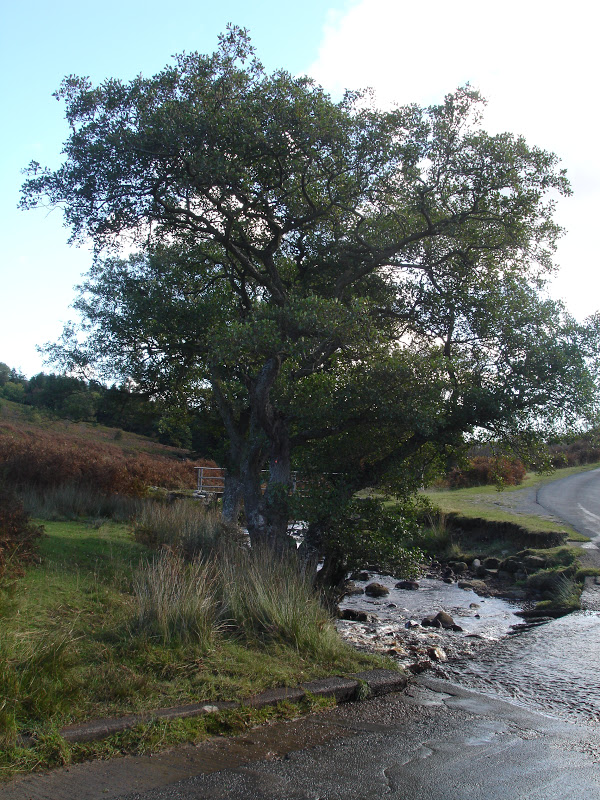
George Monbiot has written on the new threat to our ash trees, having lost so many of our elms to another kind of bug, it would be terrible to lose more trees to what I suppose we might call globalisation, plants and goods from one country to another, in this case saplings from Denmark, where the disease has affected 90% of the ash trees.  Below is a photo of an ash tree up on the downs round Bath.  They grow on the steep hillsides, forming woods along the edge of the downs.
Monbiot talks of the legend of the Scandinavian legend of Odin and the Yggdrasil Tree, so I will not expand on that story, though it appears in this country to.  Geoffrey Grigson gives the many stories that accompanies the ash tree in this country.  It was rated as good a wood as oak  as the 'most toughest and elastic' of timber for making a variety of things.  It had 'healing power', pollarded ash trees were cleft and the young child passed through to heal them of their affliction, a bit like the holed prehistoric stone in Cornwall. 'ash tree, ash tree pray buy these warts from me..
The ashen spear 'Ash, baneful weapon in the hand of a warrior' carries its magic on into ash walking sticks, bringing with it its essence of strength and sacredness. 


Ash tree caught by early morning sun


I loved the old ash trees up on the downs, one cruelly struck by lightening, apparently lightening strikes the ash so remember 'avoid an Ash, it courts the flash', don't stand under one of them in a thunderstorm.  One experiment I carried out with the trees was to count the leaflets that form a twig, mostly it is supposed to to be nine, four on either side and a singleton at the tip but you will often find eleven or thirteen leaves. 


Of course nine is a magic number, Odin hung from the Yggdrasil Tree for nine days and Aubrey Burl has something to say about in his book on Stone Circles (which I no longer own), but it is a tree that comes late to leaf, I'm sure there is a little rhythm about it somewhere...


As always for reference; Geoffrey Grigson, The Englishman's Flora

http://northstoke.blogspot.co.uk/2008/03/dean-hill.html

http://northstoke.blogspot.co.uk/2008/03/weston-history.html

http://www.guardian.co.uk/environment/georgemonbiot/2012/oct/25/ash-dieback-cameron

http://ashtag.org/

Monday, October 22, 2012

Fog and kingfisher

the water creeps up the shallow banks

Old willow slowly dying into winter
Woke up to a foggy morning and LS being very  miserable with the onset of autumn, dark mornings and then early dark evenings shorten the day even further. The turning of the seasons is so dramatic, it seems slow at first then the darkness arrives and we become cooped up bereft of natural light.
 
Well this morning we went for a walk down by the river, hedgerows and grass are garlanded with spider webs, they tremble on the wind thickly strung with beads of rain or dew. Probably one of the most beautiful natural constructions of nature.  There are mushrooms in the grass,a rich brown domed cap, and a pale creamy shaggy one.
 
The river is high, the muddy brown water swirling away at quite a pace, it is almost as high as the muddy path along which we slip.  The 'race' of the water is caused by the water being diverted round the mill and then flowing back into the river lower down, we stand on the bridge, the ducks are gossiping loudly to themselves on the bank.  Then suddenly a flash of blue from under the bridge and a kingfisher flies swiftly down the river.  I suddenly realise that the splashes I have heard must have been this blob of tropical colour fishing in the river and there I was thinking it had been fish jumping for insects. The person at my side is happy, the sighting of a kingfisher has coloured his day that lovely iridiscent blue or is it green, we watch it too swift for photographing skimming from side to side on the water.


Sunday, October 21, 2012

Always waiting for the ball to be thrown

It's Sunday, and I miss my  old Moss for a Sunday walk, tears will not bring him back but his solid companionable presence seems to lurk in the shadows.....


Saturday, October 20, 2012

Saponaria officinalis or soapwort


Autumn has arrived, each night it rains, and the garden becomes more bedraggled, the cosmos hangs on in there, the geraniums and pansies still producing flowers. Yesterday my love asked how do you make soap, and looking through my John Seymour, Self -Sufficiency book Seymour has the recipe, well we do not really need it nowadays, the process is too complicated and it is much cheaper to buy at your local supermarket. 
But it did bring back the memory of the soapwort I grew in a narrow bed under the house, its root system means that it happily expands itself and needs keeping in check, but its pretty rather untidy habit did attract humming-bird hawkmoths so it was a welcome addition to the garden.
It is not called soapwort for nothing Grigson says and I quote
"Crush a handful or two of leaves and bring them to the boil in water.  Strain off the liquid and it will make an appreciable lather" he goes on to say that it will give you a dry, comfortless, slightly stinging wash.
He goes on to contemplate whether this plant was used by the early medieval fullers as one time it was called Foam Dock, it was used to wash the sheep in Switzerland and also for linen, and taken to New England where it kept the old West Country name of Bouncing Bett......

The dunes at Holme Next to the Sea


A berberis shrub used along the wooden pathway to keep visitors and dogs off  the sand dunes presumably


Harebells amongst the marram grass

The eroded beach and dunes


Thursday, October 18, 2012

Cawthorn Roman Camps


I am not going to write much about these three large camps, Pastscape below has a detailed discussion about them.  It is said that they might be 'practise' camps, (how to build a camp in three goes;), they are pretty formidable and on the sign posts are declared as having to subdue the fierce British tribes that lived in this part of world.  Alternatively, they could be part of a line of camps to the coast from York.  Recent excavations showed Grubenhaus in their interiors showing later medieval use as well, though water is pretty absent on top of this ridge and they would have to gone down into the valley but perhaps there were wells dug.
Easy enough to find, four miles out of Pickering along a narrow lane, turn off to the right and you head into woods that surround the camps, it is a place to walk the dogs and we met a few of them.  The camps are delineated by deep ditches and banks, the lines further marked by the dark brown of heather.  One thing I noted is the absence of sheep, a photo on the gate of badly mauled sheep being hoisted into a jeep tells the tale, dogs had been attacking them.


The view over the valley from the ridge

Pastscape

Tuesday, October 16, 2012

North Yorkshire Moors


‘Sitting among the heather,
‘Suddenly I saw
‘That all the moor was alive!

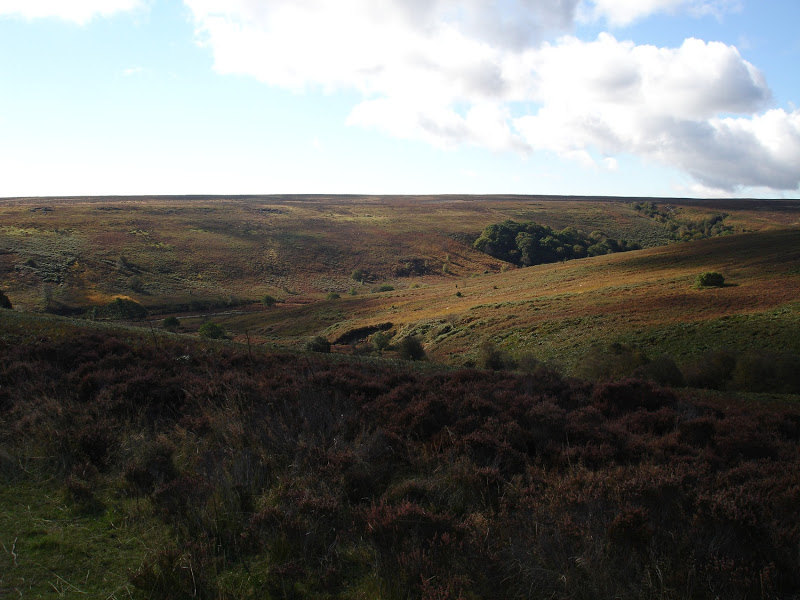
Browsing through the blogs I came upon a poem by Kathleen Raine - Heirloom, and thought how apt it was.  The first impression of the moors is the dead brown colour of the heather that greets the eye, yet always my heart skips a beat when first I see these great rolling moors, interspersed with green valleys.  Feel the pulse of the moor and it beats faintly, the tumble of rocks that fill the becks, untidy grey giants in the peat brown musical waters. Sheep stand forlorn amongst the heather, or crowd the road side verges for that useful mouthful of scarce green grass. No pheasants, they are down in the lush green valleys, filling the tiny lanes with their foolish young dicing with death as they stand uncertain in the path of oncoming cars.  No, the moor has  dark grouse with a flash of red, quietly adapted to a life of eating the tender shoots of heather. 

You can tell from the following photos that trees are sparse, they follow the line of the becks clustering, protected from the winds that sweep over these plains, forest planting around Pickering is ugly the dark green monotonous march of the evergreen firs, but the decidous trees below already have that soft touch of autumn colour, lighting up the landscape.
Perhaps there is a large restless spirit that protects this stubbornly impractical large piece of land, hostile to all but sheep and grouse, even walking is restricted to the few public paths, unless you want to wander in the footsteps of a sheep path, not knowing where they will lead.


The burning of heather on the moors


These two trees stand guard at the water's edge, their bark is smudged with white which must be some sort of mold or mildew in this damp climate.

When we came from Lastingham we took a more westerly route over the moors and passed, in the midst of the most barren stretch of the moor, a pub called The Lion, it reminded you of Jamaica Inn on Dartmoor, I think it is on Blakey Ridge.


The whole poem


'Since she saw the living skein
Of which the world is woven,'

Monday, October 15, 2012

Sea Henge

The sand dunes with a stream making its way to the sea

Remnants of old dunes


Wooden posts found from the circle

                                                              
                                                           The double pronged entrance

The central upturned tree stump

Seahenge.  Of course it is not a henge, not even a stone circle but built with wooden posts around the spring of BC 2049. The diameter of the circle was 21 feet (6.6m) with 55 closely fitting posts the circle averaging out at about 10 foot high. The land on which it stood would have been different, saltmarsh protected from the sea by sand dunes and mud with a mixed oak woodland nearby.  Tis a place of sacred unknowingness, you may laugh but that central upturned trunk its roots reaching out to the sky must hold some sort of secret. The archaeologists think that it was used for excarnation, either for a great chief, or maybe for the small group or clan who lived here.
When I first saw the upturned tree, my initial reaction was that it was somehow a dinosaur, not quite dead, still throbbing with slow life.  It has PRESENCE this tree, blackened and deeply fissured with age and a few model carrion crows perch  menacingly on the edges of the mock-up wooden circle help create the drama.  The tree stands in its glass cage watching over the recovered wooden posts of the circle as they curve round on their stand backed by a large photographic representation of the beach on which the circle was found.
This beach at Holme-Next-to-the-Sea must be your first port of call, drive down to the village and turn left at the crossroads, (where it says Peddars Way) and there is a car park further on. Walk over the wooden boardwalk by the dunes, the sand stretches for ages down to the sea, and on the horizon about 50 sea wind turbines stand like ghosts, blades idly turning. No mention of where the posts were found on the information boards, and I suppose if you were lucky and walked further on and the tide was out you may find the second wooden circle, called Holme 2.
There are several theories mooted on the boards that accompany the timbers, one is to do with the stripping and non-stripping of the bark off the posts, most timbers had there bark left on but one had been stripped, this one called ‘timber 30’ had its outward facing bark stripped, maybe to represent an important person, maybe because it had been struck by lightning thereby leaving a white bark.  Firstly, it was said that the closeness of the posts could be that the whole site was supposed to represent a tree stump, or maybe each individual post represented a person, there were 55 posts in all.    The orientation of the first timbers sunk was to the Midwinter sunset in the south-west and the Midsummer sunrise in the northeast.
About half the timbers were placed upside down, it could have been due to the fact that if driven into the ground right way up the circle would have leant inwards towards the centre.  By placing them upside down they cancelled this inversion, but there again at other Bronze Age sites inverted objects were associated with death and human remains.
The narrow ‘entrance’ double pronged timber was labelled 35/37 in the initial excavation because it was thought to be two separate posts, there is a blocking timber 36 in front of the entrance.
The great central oak stump, over 50 axes were used on this tree, and 3 holes bored into its lower trunk show where it was dragged by honeysuckle ropes. Measuring about 2 and half metres high by approximately the same width, think I read somewhere it was 150 years old when cut down, there are two suggestions for why it was used, one being the excarnation theory the other “a symbolic representation of the fruits of the earth and the magical powers of trees, or perhaps a gateway to the underworld”
What to make of it all? Firstly, one has to agree with the decision of digging the timbers up, if only to help keep them for future reference and safe from further destruction by the sea, and because of their special uniqueness.  The heart does stop for a few seconds as you view these old monster wooden posts, my first impression was of the old wooden Scandinavian gods found in the bogs – strange twisted and  shaped…  Alien, scary and dark!  Imagination can run easily with Tibetan ‘sky burials,’ especially as part of the exhibition houses another upside down tree trunk to make the point that the roots easily cradle a human being.
Lynn Museum can be found to one side of the bus station, so simply head for the train and bus station and park in the car parks round there.


Whitby - October 2012

This is Peperoni, after finishing her tea, watching the sparrows outside in the bush.
Back home after a fortnight stay in Whitby, mostly beautiful autumn weather, though a phone call from Aggie this morning says it has turned.  Aggie is the person who will let the cottage next year and today she goes to photograph it, so I have 'dressed' the beds as best I can... She thought her key was lost but found it luckily because spares are inside the cottage at the moment! Masses of washing for the machine but the garden has fared well here, plenty of rain judging by the state of the buckets.
We pottered around the town quite a lot of the time, this weekend has been 'Wartime Britain' with people dressed up for the first World War.  Dress wise it was pretty fabulous, fur coats and pretty dresses worn with nylons, lots of women tottered down Flowergate on high heels, alongside smartly dressed business men, the armed forces were also much in show, sadly I did not take any photos.
Seahenge was fabulous, both the beach and the exhibition at the museum, moors of course, and a visit to Lastingham church to visit the crypt - this by the way is where Saint Cedd (Chelmsford) started the early northern christian church at Lastingham, but more of that later.  We also went and found the Cawthorn Roman Camps, three to be precise, large and pretty daunting if you were a native...

The following, two very windy photos, were taken up at Whitby abbey.  Gorgeous horses standing, not too patiently, the driver has a lovely gloomy face as he glares into my camera, but who could resist those horses. They travelled back home in a horse van and I expect went for a good run round their field....


Thursday, September 27, 2012

Miscellaneous

Been packing this morning, I don't have many clothes which comes as a bit of a surprise, lot of it is due to  me hating shopping, can't be bothered to walk round shops anyway, and when a particular dearth of something comes around, it is mainly because a lot of stuff is in the wash regime, I will hasten to M&S online and order some necessity.  Sometimes I want to take myself in hand, order some natty jackets and matching skirts/trousers but never do.
So 2 minutes packing, or slinging some clothes into a bag, my love of course is so ultra neat that he looks on in horror at my untidiness.  This tidiness comes from past working in the studio and working in Japanese studios and museums having all his tools and brushes laid out precisely on the work bench, so that now it has infiltrated to books on tables, knives and forks it becomes a joke between us my habit of distributing books haphazardly on all surfaces, patchwork materials and my spun wools in baskets and dishes.
Today I have decided to spin 'Pegasus's' apalca fleece, a deep dark brown it leaves smudges on my fingers, I know Pegasus the alpaca resides in his field with companions just along the road to Middle Mill from Solva, such knowledge gives me pleasure as I spin. It reminds me of Solva Mill which I follow on Facebook, and I have a faint sense of homesickness.  But we are off on saturday firstly to Seahenge, been reading Francis Pryor on it, his wife Maisie conserved the timbers at Flag Fen before they went into the museum.  It is not a henge of course, maybe not even a circle more a shrine with the central upturned tree used for excarnation, Pryor likened it to the Street House ritual enclosure coincidentally, which is just outside Whitby, and I had just written about!
After Seahenge Whitby of course on Sunday, both looking forward to it, even if it is only for decent fish and chips and the Magpie restaurant, and my favourite walk by the East cliff, though I must not forget my grandchildren.
Also been reading Britain After Rome (The Fall and Rise 400 to 1070) by Robin Fleming, fascinating the so called 'dark ages' but it was complete breakdown after the withdrawal of Roman authority from Britain. Can you imagine our councils just not being there, roads and towns fell into disrepair, crafts disappeared no pots made, they were even to be found using the old prehistoric cremation urns as domestic pots, I suppose having emptied them out first. 

Tuesday, September 25, 2012

Inside Welsh homes

Just love the old television in the corner

Photos collected by 'The Peoples Collection - Wales, of the ordinary, humdrum lounges, kitchen and bathrooms of Wales over the 20th century, fascinating for the curious ;).


Saturday, September 22, 2012

Peperoni

This is an ammonite quilt, that was displayed in the  quilting shop in Brunswick Road.
Picking up our threads in Whitby;  

Who is Peperoni?  Well she is a small silver-grey cat that visits the yard in Whitby.  Does she belong to anyone? I am not sure, but last time we were there she made her presence felt.  Our neighbour up the steps, is an old fashioned hippy, long grey locks and a loud Scottish accent, and it is here that Peperoni will head for morning breakfast, we will see her out of the window tail held high as she bounces up the steps.  Paul loves talking to (well just lets call him F) F.  We always get missed phone calls from him and we both picture him standing outside on his small balcony looking out on to the wilderness of wild flowers in front of him that is supposed to become several houses.  This walled piece of land owned by an absentee Irish millionaire, who also owns several other properties in Whitby, may not be developed, or it may, but long may it be a wildlife habitat.
This morning F said he was training two carrier pigeons as their phone calls always seem to miss each other.
His friends often pass our window, a Viking goth would perhaps explain one, Whitby is full of colourful characters another neighbour in the yard had her brothers down for the folk music weekend, songs and music could be heard coming from the cottage and A had bought a ukelele to practise on, as she has as yet to learn how to play...
But to return to Peperoni, a very pretty little cat, she came to inspect the cottage a couple of times, waltzing round the sitting room , under the bed on the first floor and then doing a daredevil act on the top floor window, which was open, till I rescued her.  We have seen her curled up fast asleep in the pub over the road,  M next door doesn't like her and so she gets shooed out, Paul worries about her crossing the road from the pub to the yard. Hopefully I shall take more photos when we go back and I shall try to capture Peperoni if she is still around.....

Friday, September 21, 2012

Sea Henge


Taken from  this BBC article
Holme 1
We will be going to Whitby in a few days, but firstly my son in law and Tom my eldest grandson are coming this weekend to deliver Tom to uni, and then the following weekend we shall travel.  We have decided to stop off one night in Norfolk to see the fabulous Bronze Age Seahenge timbers at Kings Lynn museum, and I definitely want to go to the Holme-by-the-Sea beach where they were first found and caused such controversy about their lifting from the sands.

There is a reconstruction of the timbers, smooth side facing inward, bark on the outside and that fabulous upside down tree root in the centre, a mystery as to why, but in feels like the Celtic otherworld/underworld has some meaning here. The controversy centred around the fact that these timbers were sacred according to the pagan communities and should be left in situ to be slowly eroded by the sea.  There is another timber circle close by, to be left in situ by English Heritage, this is called Holme 11 and there is apparently a timber trackway to this timber circle.

The Sea Henge timbers went to the  Flag Fen Centre for immersion in water and a wax substance that would penetrate the timber and preserve them.

Map reference; Holme 1 - TF711452 Sea Henge,
                         Holme 11     TF752453

http://en.wikipedia.org/wiki/Seahenge


Trees mirrored in the river one cold and snowy morning

Monday, September 17, 2012

A walk by the Chelmer river


The gypsy ponies are doing well, fat and sleek in the sun, their foals play and joust round the old leat.  I counted about 18 ponies, the picture sequence shows the first mum charging down the field for a drink, the second are the two foals pawing the water, and the third well I think that is the stallion at the back, but not the old one.
This is the old stallion from 2009

Peaceful old Chelmer river
.

Saturday, September 15, 2012

Loftus - Street House neolithic burial/Anglo-Saxon Burial

Saxon Jewellery
Street House Anglo Saxon Cemetery
Loftus, North Yorkshire a slightly nondescript town, near the coast between Skinninggrove and Whitby and not far from the Boulby Mines.

There are times when history takes you by the throat and shakes you, today I came across a  Saxon princess grave from the 7th century that  had been excavated earlier on in this decade, it was a 'bed burial' (only 12 such exist up to the present time in this country)  several rather beautiful brooches were discovered in the grave.   Saxons are far and few up in North Yorkshire and it is supposed that she had married a local man.

                                                         ---------------------------------------------------------------------
The Wossit Barrow/ritual enclosure

Then on delving deeper came across this Neolithic cairn which was overlaid by a Bronze age round barrow, which is unusual but, anyway to me, fascinating, this long history of burial on one site.  There is not much to see though I note on an old map that a tumulus was marked on this farm.

An Early Neolithic cairn and mortuary structure overlain by an Early Bronze Age round barrow. Excavated in 1979-81, a shallow plough-damaged earthwork circa 6 metres in diameter proved to represent a multiphase Neolithic funerary/mortuary monument. An east-facing timber facade fronted a narrow mortuary structure set between low banks of clay and stone. Behind the mortuary structure was a sub-rectangular enclosure defined by a stone kerb and containing two paved areas. The latter is interpreted as a mortuary enclosure, used for the initial laying out of the dead prior to deposition within the mortuary structure itself. The latter contained the fragmentary burnt remains of several individuals. The facade comprised near-contiguous timber posts. The largest at the centre, directly in front of the mortuary structure (another post setting occurred at its rear). Most of the Neolithic pottery recovered came from the upper fills of this facade trench. In front of the facade were traces of two rows of post holes, possibly representing an avenue approach or other structure. Radiocarbon dates suggest that the monument was constructed in the early to mid 4th millennium BC. Subsequently, the whole monument was converted into a single low trapezoidal cairn by the extension of the mortuary enclosure kerb as far as the facade, and the addition of cairn material over the whole monument behind the facade. The timber elements were burnt, and subsequently unburnt timbers were removed. In the Early Bronze Age, funerary or related practices immediately preceded the construction of a kerbed round barrow over the eastern half of the long cairn. Despite plough-damage, four collared urns and an accessory vessel represented secondary cremations inserted into the mound. Two of the collared urns were associated with Grooved Ware sherds. A deposit of circa 20 jet buttons was inserted into the tail end of the long cairn. The flint assemblage included some possibly Mesolithic items.


Tuesday, September 4, 2012

Indian summer


September has arrived with beautiful weather, some would say hot, but I shall desist from saying it.
Yesterday we wandered along to Paper Mill, lots of people at the tea place, slice of carrot cake and a mug of tea went down nicely.  You can feel autumn in the air though, it is in the muted  colour of the grasses and trees, a slow turning of the season.  In the garden I cut the heads of hydrangeas and lacecaps for drying for winter vases, remembering the golden rod and tansy I used to cut years ago for the same purpose, there bright yellow colouring turning to biscuit over the winter months.  The bumble bees dance ahead of me in the garden alighting on the cosmos and two collared doves tamely peck round the lawn as I garden, we are used to each other.
The willows on the river are a lovely silver-green, it never ceases to amaze me this soft green, the leaves turning in the wind silverside up and that soft whooshing rattle of noise.  I should be dyeing some wool, but natural materials are hard to find, so I continue with my patchwork.  A design has been decided on 4 square pattern alongside a pale cream square, Cotton Patch has sent me a catalogue with a whole load of templates and rules, I am hardly past the 'square' stage so a 'log' design is some way away yet.

A new book to read, To the River by Olivia Lang, it is said to be in the style of Robert MacFarlane, I am not so sure  When it hurts, we return to the banks of certain rivers, gives us a perception of one of her motives, a past love affair haunts the pages, also history comes alive along this particular river, which is the River Ouse, famous for Virginia Woolf's suicide.  Laing has done a great deal of reading, Woolf quotations meander through the chapters, but a return to the wilderness it is not.  This southern river is too tamed, to near to towns to give a feeling of lost landscapes, it is more a historic trail, a palimpsest of historical layers, one page sinking into another,  and yet her descriptions of the wild flowers that  lined the  ditches of fields of wheat, shows that our native wild flowers are still with us.  Still I have not finished reading, yet to arrive at the sea - the endless motion of water. 


one step-width water
of linked stones
trills in the stones
glides in the trills
eels in the glides
in each eel a fingerwidth of sea

Alice Oswald - The River Dart.


Sunday, September 2, 2012

Changes, changes

A lot has happened in the last week, my family in Whitby have decided to move back to Rugby, which will of course be nearer to us in Chelmsford.  This has not shocked us, my daughter had been unhappy in Whitby for quite a while, the shock came when having only put their house on the market last week, two offers were made on it and they are off looking for a new house this weekend.
One of the motivating factors was my eldest grandson results in his 'A' levels or whatever they call them now, he passed with a distinction in law (he wants to work in the police force) and he gets his uni of choice which is near London and us.  I shall miss them in Whitby but we will still keep the cottage, because everyone loves it.  Sometime next year it will go with a holiday letting agent mostly so I can pay utility bills on it, I can have it when I please for family and friends so the contract is not too stifling.
This week I also experience difficulty with Eblogger and photos, so I turned to Wordpress blogs, their photos come up a lot clearer.  I've used WP before so it was not too difficult, but still like the comparative ease of this blog, and it would be sad to leave it.  There again my computer has been playing up in other areas, I have a feeling it is to do with these ubiquitous cookies that appear every time you go to a link but who knows..... Northstoke2


Tom looking 'cool' note both the younger children on their computers, they all have mobile phones as well, though the little one has not got an account!

In the dark wood


A walk through Blake's Wood to see if the sweet chestnuts were ready (they are not) and some fungi hunting, but all there was to see were puffballs, creamy yellow by the paths. The woods were dark, overgrown with young briars and grass, summer is slowly dying.  No wind, but the trees talked amongst themselves, gently creaking and snapping, this is part of an old wood's history, we came to the coppiced bit with one tree tall standing amongst the great heaps of branches shorn from the felled trees. A hawk flew off, cross perhaps because we had disturbed his sanctuary, strangely there are not many birds in the wood, a tiny mouse-like wren alighted on a stump as we walked by but apart from wood pigeons and the far 'chink' of a blackbird it was ominously silent.  
The brightest thing we saw was  fireweed, Rosebay Willowherb something I had been meaning to look up for a long time.  We all know its history, this ragged flower of the roadside, said to sprout on all waste ground enlivening the areas round towns.  So turning to Geoffrey Grigson I learnt a little of its history.
Gerard is the first to talk about it, he grew it in his garden in Yorkshire and describes it thus
"it grows to the height of sixe foote, garnished with brave flowers of great beauty, consisting of fower leaves a piece, of an orient purple colour".
It was the industrialisation of the country alongside the railway and the second world war that spread it far and wide, those "downie matter" seeds blowing far in the wind, coming to rest on fire bombed land, it has become so 'common' we ignore it.  
In America, around Seattle (remember Grigson is writing in 1958) they make Fireweed Honey apparently and it grows in greater profusion than in England.  As you can see from the following photos Angelica is also growing in this damp environment, a rather splendid plant, dark purple stems and feathery white umbrels.
Whilst reading about fireweed came across that other 'common' plant that has spread along the railways, Oxford Ragwort - Senecio Squalidus. Yes, it was named as a squalid plant, whether because of its habit of travelling far and wide or because it just happened to alight in squalid surroundings I'm not sure.  But Grigson defends it stoutly as a cheerful plant like fireweed (though I do hate these two colours together (yellow and pink).
So what else spreads itself with wanton ease, well the pretty little Ivy Toadflax which grew in my last garden hugging the steps and walls for shelter and warmth, and of course the Red Valerian which adorns our walls with equal enthusiam.