Wednesday, November 18, 2009

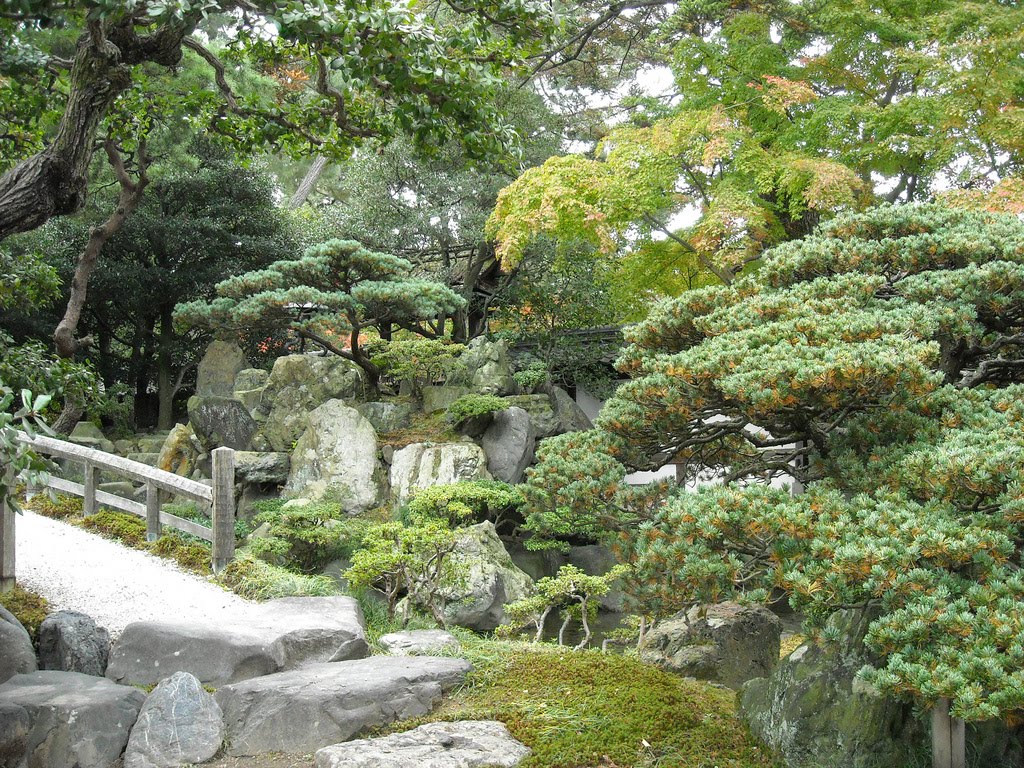
Imperial Palace Gardens - Kyoto


Last week my partner went on a business trip to Japan, though his 'business trips' are about the crafts of silk, papermaking, dyes, etc... so the next blogs will be a compendium of some of the things he photographed....
The photographs below are the Imperial Palace and its gardens, and the palace itself, opposite the hotel he stayed in. Japanese gardens are fascinating, cool, calm, serene are the words that come to mind, the moss gardens are probably the most beautiful. Completely different from an English garden, formalised or cottage, what you do notice is the lack of flowers, the elements being rock, trees and shrubs, water and moss,* and of course the famous symbolic raked gravel surfaces that can be found at the Imperial Palace or the temple garden of Ryoan-ji.
Autumn colours of the maple making striking combinations against the evergreens, and the twisted branches remind you of bonsai....., the only similar thing that I can think of in England at the moment is the Westonbirt Arboreteum which also has the vivid hues of orange and red maples in Autumn.
*Moss of course is one of my favourite words, its the name of my dog, its soft sound invokes images of pillow-soft green mounds, its has a symbiotic relationship with water and stones, mounding softly it embraces the stone, it revels in the moist air, turning emerald green, squiges in bogs with that strange sucking noise; its minute flowers a reminder of a time long ago when the earth was frozen - its as old as the stones themselves sometimes and like lichen, which takes such a long time to form on gravestones reminds me of the first beginnings of life on Earth.
Click once on photo, then once more on small photo, which will then become full screen.


The Palace , no longer in use, with mannequins


A raked surface


Ryoan-ji temple garden

Tuesday, November 17, 2009

Waldo William 'fields'

Waldo Williams's memorial stone


For the last few days I have trying to find time to write about Iola Morganwg, the 18th century 'archdruid' for the revival of Welsh druidry, unfortunately he created a myth with his translations and poems, a vivid reconstruction of a 'truth'.
But all the time another person nagged at my mind 'Waldo' who's stone monument I had seen on the moors below Carn Meyn in the Preseli mountains, so putting Iola aside for the time being, a quick note on Waldo Williams.
Williams when young lived in the village of Mynacholog-ddu and details of his biography can be found here.
The Preseli mountains has a very strong pull on my mind, its landscape and stones, the fields nestling below the mountains, the hundreds of sheep scattered on its slopes in summer, the beautiful loneliness of it all would lead to a life of contemplative ease. The great stone cairns of Foel Drygarn that sit above the village of Mynacholog-ddu are a stark reminder of the high office bronze age leaders were afforded in death, and the great crested stone ridge of Carn Meyn reminds us that such manifestations of our earth had enormous symbolism to the prehistoric people who lived here, and maybe transported some of the stones to Stonehenge.
So to his rather beautiful and famous poem, written in Welsh I believe, here it is translated from another website.


Those fields – I’ve walked across them - they are
Extraordinary fields, though inaccessible to the seeker
After transcendence this is no loss for the page
Holds them in view and they extend into the margins
Between field hedges and the nets of the Hunter

In many places and times where time
Is arrested and held captive by a tether
Of stillness long enough to feel chastened by silence.
Sunlight touches a wall on a summer afternoon,
Shadows enclose a moment which passes from forever

To forever: Such blessings are felt to be precious.
But hearing beyond them voices calling in a common
Tongue of work and worship echoing through centuries,
And knowing that they witness this moment
When all is still, so that being alone

Is to be with them, resonates beyond solitude.
Voices heard in the echoes of whistling lapwings
Tremble to life over empty meadows; each hand,
Each tongue unique in the passing of time yet fused
In a moment making one of many things.


Foel Drygarn with Carn Meyn in the distance


Gors Fawr stone circle

Foel or Moel Drygarn stone cairns


A marvellous, and dearly loved companion


Peak Oil

George Monbiot on Peak Oil, or maybe the end of oil, its not happy reading, though I have been reading about it for several years now, but one of the books on the subject is Richard Heinberg's The Party's Over (Oil, War and the Fate of Industrial Societies) .


http://www.monbiot.com/archives/2009/11/16/if-nothing-else-save-farming/?utm_source=feedburner&utm_medium=email

Saturday, November 14, 2009

Autumn storms and the last of the leaves

A photo of the 'quiet' before the next storm

As the rain and wind beat against the windows this morning, with the storms that are making their way from Wales to the east coast. ....

A group of trees across the green, with the last silvered leaves in its topmost branches, become illuminated against a western dark louring sky from the sun who was making a brave but futile gesture in the east this morning.... with a touch of photoshopping to make it more dramatic...

Friday, November 13, 2009

Notes

The subject of whether they actually existed or not has always fascinated me, firstly one must make the distinction of actual druidism which may have existed in the Iron Age, and the made-up variety of 'historical' druidism that wound through time after that, culminating today of course in the neopagan druidry.


Ronald Hutton's - Blood & Mistletoe - arrived this week from the library, a beautiful unread copy (so there's not much interest out there then). For me Professor Hutton is the expert on the subject and this book does the subject justice, just under 500 pages.


Dipping in and out and slowly I begin to learn of the effect of druidism on the scholars of the 18th century and the important change it bought to the understanding of megalithic monuments. Stukeley and Borlase who both wrote and illustrated outstanding works on megaliths, are of course motivated by religious curiosity, their interest stemming from an Anglican viewpoint. So the following will be the bits I find interesting in all this, firstly of course turning to John Wood the architect and his design of The Circus in Bath, in this article which I wrote a few weeks back.....


Hutton says that John Wood was influenced by the works of Sir Isaac Newton (Chronology of Ancient Kingdoms Amended), and Wood took for his model the Temple of Solomon as a way of interpreting and designing the Circus, the design reflects Wood's esoteric interest.


It is based on the Masonic (Bath still has a very ugly, though some might see it as beautiful, Masonic hall) sign of of a triangle within a circle, incorporates the mystical sequence of druidic or Pythagorean numbers which he claimed to have found at Stanton Drew, and, as a sacred structure occupied by houses, reflected his concept of the great circle at Stanton Drew as a Druidic college.....Lest anybody miss, at a glance, its connection to Druids he topped it with a row of giant stone acorns to represent a grove of oaks. He also gave it superb acoustics, fitting the central place for ceremonies because words spoken aloud there are naturally amplified by the curve of the surrounding buildings. Functionally the Circus is a series of residential blocks, symbolically, it is the first Druidic temple to be erected in Britain since ancient times, created as the testimony of faith of a passionate, if highly unusual, Christian. It may, in fact, be the first stone temple ever built in the name of druidry... Ronald Hutton p107


Which is a thought to ponder on given the fact that modern day druids tend to treat Stonehenge as their temple, but I expect the residents of the Circus would not be highly amused.


William Borlase; A name to conjure with, his book is out on the web with many fascinating illustrations of Cornish Cromlechs, a typically 18th century book, ponderous and full of marvellous conjectures and fantasies that only an 18th vicar can do, especially when they only 'work' on Sunday. But that is to be cruel to Borlase, for he spent a lot of time tramping the moors of Cornwall to record the standing stones, dolmens and stone circles, he thought were put up by the Druids. In a brief resume Hutton says that Borlase represents the standing stones as their idols, the dolmens as their burial places and the third as the setting for acts of worship and judgment, I cannot fail to mention this...."He concluded, that Rowlands had been wrong in identifying the megalithic chambers - the dolmens, cromlechs and quoits of popular terminology - as Druidic altars, because of the difficulty of climbing and balancing on top of them to perform sacrifice"


His parish encompassed the great area of Penwith, and perhaps a much later piece of prose written by Edward Thomas in the early 20th century underlines the profound effect that the inspirational writings of Borlase had....it shows just how much of our history is caught up in a romantic past that may have no bearing on the reality of prehistory at all......


Nineteen tall, grey stones stand round a taller, pointed one that is heavily bowed, amidst long grass and bracken and furze. A track passes close by, but does not enter the circle; the grass is unbent except by the weight of its bloom. It bears a name that connects it with the assembling and rivalry of the bards of Britain. Here, under the sky, they met, leaning upon the stones, tall fair men of peace, but half warriors, whose songs could change ploughshares into sword. Here they met, and the growth of the grass, the perfection of the stones (except that one stoops as with age), and the silence, suggest that since the last bard left it, in robe of blue or white or green – the colours of sky and cloud and grass upon this fair day – the circle has been unmolested, and the law obeyed which forbade any but a bard to enter it… And the inscription on the chair of the bards of Beisgawen was “nothing is that is not for ever and ever” – these things and the blue sky, the white, cloudy hall of the sun, and the green bough and grass, hallowed the ancient stones, and clearer than any vision of tall bards in the morning of the world was the tranquil delight of being thus ‘ teased out of time’ in the presence of this ancientness….


The romantic image captured in prose, but going back to earlier poets of the 18th century, who are by now creating a view of Britain that is nationalistic and stems from a past when the noble 'druid' had a say with the many kings of both Ireland and England...

With sacred mistletoe the Druids crown'd,

Sung with the nymphs and danc'd the pleasing round,


they had now become priests of nature, gone were the horrific human sacrifice in the gory groves, Hutton likens them at this point in history to flower-children, and also at this time beginning to take a different role as Bards, the true representatives of the wild and beautiful landscapes of Britain; here we find them, meeting at night in a sacred grove, white robed and carrying harps, only offering up white cattle for sacrifice.. All of course made up as the fancy took them, echoing down of course to the early 20th Druid, so that when we look at a picture of Stonehenge in 1905 there is a serried rank of Druids staffs raised in front of Stonehenge...


Turning to William Stukeley so much a part of the Stonehenge and Avebury experience, books have been written about this 18th century person, that it is difficult to even paraphrase Hutton on his character. That he meticulously and methodically recorded Avebury with such enthusiam but somewhat marred that enthusiam with his need to point to a Druidical beginning for the stones, his book Abury - A Temple of the British Druids says it all.

Hutton says that Stukeley was also an admirer of Sir Isaac Newton (similar to John Wood who also not only followed Newton's ideas but Stukeleys' as well)...what it entailed was "to understand the natural world and (thereby) to understand the divine plan that underpinned it" doing this though through the more orthodox lense of the Anglican religion.

Stuart Piggott had admired Stukeley's work up to the 1720s when he had recorded without a religious bias, and it was only when he became ordained later on that Stukeley began to elaborate his story of the monuments being attributed to the ancient druids.

Further research into the extensive papers and diaries of Stukeley revealed, at least to the author David Haycock, that Stukeley always had a "strong streak of mysticism with which he interpreted ancient remains in accordance with set notions, concerning the nature of primitive nature" This theme was of course to be found in the writings of later 19th century vicars such as the Reverend Smith at Avebury and the Reverend Skinner of Camerton. And a further note must be made here on the subject of freemasonry which was also taking a hold at this time..

"The nature of primeval religion, and its relationship with christianity - were incorporated into the mythology and symbolism of freemasonry - spreading through England rapidly in the 1710 and the 1720s."

Stukeley took up a post in Lincolnshire as a vicar, he was by now married but unfortunately his wife had suffered two miscarriages, he had apparently left London in a huff, as his ideas were the butt and ridicule of his friends and mentors. But when he settled in to his new home he created a garden and here part of his 'mystical' relationship to Druidry and the ancient monuments comes to the fore, for it was in his garden that he created a 'sacred landscape'. It included a Temple of the Druids, which consisted of concentric circles of hazels and evergreens modelled on Stonehenge, an apple tree with mistletoe growing in its branches was at the centre of the circle. Apparently he also had a 'tumulus' beside the temple and a little chapel which contained a roman altar. One of the babes from the miscarriage was buried in the camomile lawn that faced the altar. A rather sad footnote to end on, this man possessed by an illusionary religion that coloured his viewpoint of the 'old stones', but perhaps all the paraphenalia in the garden was an expression of the vision he had invoked from a long gone history, none of which was true, a human desire to create a belief system once removed from the Anglican church he was avowed to.

Wednesday, November 11, 2009

The last Wolf at Leinster

Taken from the Creative Commons, this wolf probably comes from Canada!


Going through the archaeology news as I do every day, the following article in a Canadian paper tells the fate of the last wolves in Ireland who were exterminated during the time of Oliver Cromwell. Its a sad indictment of our human effect on other creatures in the environment.


The other piece of news that caught my eye was Egypt's museum directors asking for the Rosseta Stone back, again the high handed way colonialism took valuable artefacts from subject countries must give pause for thought.


And perhaps the fate of Bath and how near it came to losing its World Heritage Site status, and of course since the Western Side development is yet to be built, might lose it in the future;
The Southgate project which is mentioned as finished replaced a 1960's single storey concrete block, in this photo the pastiche neoclassical features are shown, again there height is a problem, and it very true that you could see greenery from any part of Bath (the seven hills of Bath) when you looked up to the skyline, these new buildings obscure the view from this side of the city....

Sunday, November 8, 2009

Winter arriving


Clearing the mind and sliding in
to that created space,
a web of waters streaming over rocks,
air misty but not raining,
seeing this land from a boat on a lake
or a broad slow river,
coasting by.


Taken from Gary Snyder's Mountains and Rivers without End, it reminds me that the mind should be peaceful as we contemplate the happenings around us. Darkness greets us in the morning and the land turning so quickly towards winter, is becoming grey and monochrome after the sharp colours of autumn.


The birds rise late, the host of sparrows that live in the hedge just across from the house are not so noisy, but the starlings are still here. The young can still be distinguished by their bright colours. I had never come across so many starlings massed together before, and this summer watched them come down in the garden to feed. The young formed a creche, so sometimes there was as many as 20 to be seen, they learnt to bath in the clay pot, perching on the edges, watching each other, they would take courage and jump in splashing their wings clean.

The same comedy was enacted by a young blackbird, a rather nervous youngster who was always getting chased off by his father, at least I think it was father, for he followed him around in a rather forlorn manner. When he got chased off, he would hide under the shed, and though the older bird would not let him bathe with him, the little one would come out when the father had gone and very bravely practise washing in the pot - though he was obviously frightened.


The poem at the top reminds me of all the rivers, brooks and streams I have gazed down into this summer; seeing the great water lily leaves floating just below the surface, pondweed a green haze on dark waters. The rushes and tall spikes of irises, intermingling with meadowsweet and mallows. The fish swimming lazily in the mill pond, bright gleams of sun on water and the small dabchicks 'walking on water'


Coggeshall Abbey, the mill is situated behind the large farmhouse here....

Thursday, November 5, 2009

Photos

Walking along the river yesterday, it was only a few days ago that I caught the soft orange glow of the autumn landscape, yesterday the steely grey tones of winter are starting to creep in. A storm of rain and wind brought many of the leaves down, the river is full, and is starting to lap over the top of the old lock gates. Ducks are appearing in the river and the mill pond, and a weir was revealed from the mill to the river which we had'nt noticed before. The handsome black horse is a bad tempered creature, ears back when we approached, I soft talked him and stroked his nose but he is probably a miserable creature to ride! The gypsy horses, were at their gate again watching the world go by, or waiting for tea I don't know, but as I have to dive into a hedge to photograph them, the black gelding always looks solemn as he peers at me curiously - far more trustworthy than the elegant one in the field.


Wednesday, November 4, 2009

Mushrooms


As I was making a stuffing for two very large mushrooms this mornings, my mind strayed back to Shirley Conran's words 'life's too short to stuff a mushroom' and thought well I'm glad that occasionally we find the time to stuff one! Philosphical thinking when we prepare food is probably a good excuse, but the end results are always rather delicious.... this morning, a bread mix I found at Sainsbury, containing parmesan cheese and dried tomatoes makes tasty rolls, whilst homemade fish cakes of salmon and spring onions will go nicely with the mushrooms...
But after finding mushrooms on sunday and not being allowed to pick them I turned to Susan Harley's Food in England for some advice on English mushrooms.
Well she loved her mushrooms too and has written a whole chapter on the subject.., names to conjure with.....

Common field mushroom (Psalliota campestris) is dainty pick and white when young turning brown, then almost black, as it grows old.. You will find them in pastures, normally where cattle graze. They may be anything from 4 to 24 inches across!

Horse mushroom (Psalliota Arvenis) is a clumsy version of the field mushroom. The top is thicker and the stem lumpy, and the colour of the gills less pink. The smell is that of field mushroom. Note if a horse mushroom stains yellow when cut or bruised(not a faint tinge but a definite bright yellow -as if dabbed with mustard or egg yolk -discard it as it may be be Psalliota xanthoderma which, though not deadly, has been known to cause illness
It is the solitary dead white fungus that should be disregarded with suspicion. It is the death Cap (Amanita phalloides) which is most dangerous.

Fairy Ring (Marasmius oreades), are best for drying, they are not always true to their habit of growing in rings, especially where lea has been broken. But the delicate 'fairy ring mushroom' is unmistakable. They are seldom more than 2 inches across, and carried comparitvely high on slender stems. The gills are deep and very regular, one long one short, like the minute marks around a clock. The top is buff, and the gills are very much paler, the slender stems are stringy and tough so cut them off.

The puff-balls (Lycoperdon); The really giant one (lycoperdon giganteum) can be as big as a football, both large and small puffballs taste exactly the same. Their texture - solid white, like smooth, white cream cheese, and the outer covering is fine as white kid. .....

Cooking; Smallest puff balls, walnut size, are best dipped in batter and fried like rissoles. Drain and serve as a pebble beach around a pool of green spinach. Medium sized, are rolled in flour, pepper and salt, then drop into an earthen ware pan with barely enough milk to cover, and simmer to cook. Thicken sauce after cooking, pour back over the puff-balls and garnish with scarlet barberries and green parsley.
Giant puff-balls are sliced, and dipped in egg and milk and then fine dry breadcrumbs. Fried in hot bacon-fat, drain on kitchen paper, pepper and salt and serve piping hot, sprinkled with cider or vinegar..

Chanterelle (Cantharellus cibarius); One of the prettiest of fungi. You find them, suddenly, in the autumn woods, sometimes clustered so close that they look like a torn golden shawl, dropped down amongst the dead leaves and sticks. They are all the same clear, egg-yolk yellow, the stem coming up straight, and springing and spreading stiff as a tiny fountain spurting gold. The top surface is damp and glossy yellow; the underside crinkly matt yellow; and they smell faintly of apricots.

She goes on to list more edible fungi and her writing is a marvellous description of the rich harvest of mushrooms in general before the advent of modern farming techniques. Though I am nervous about picking and cooking mushrooms and perhaps a course is called for, it is wonderful to think how the countryside furnished such a rich culinary diet, and though the warning nowadays is all about the deadly fungi, (and if I have time will give her description of the Death Cap,) the funny little tree drying mushrooms before a fire is evocative of a self-sufficiency that has become extinct in this country.


Sunday, November 1, 2009

A Walk


Today the wind and rain is beating against the window, but yesterday we had another fine warm Autumn day, a few fireworks on the green but no 'trick or treating'. So we went for a walk in the afternoon, though we stopped off down a lane to buy some vegetables. A smallholding, we get our logs from here, plants and vegetables. Yesterday a large homegrown cauliflower and a 'hispi' cabbage, plus those classic flowers of autumn - chrysantheums, a lovely red brown bronze colour. Pansy plants for the garden, I'm sure she makes no money from selling her stuff, but its nice to see and buy something local.
The walk was around a field which we occasionally stop at. Here once I watched a pheasant and his mate solemnly drink from a puddle and then off into the field they wandered. Today I saw another (same?) but he ran across the road and did'nt stop running till he was a little speck in the ploughed field. There was a lot of young pheasants in the field, so perhaps they are his offspring.


We wandered around our field, past holly in the hedge with bright red berries, along the ridge the tractor makes, fresh mallow leaves of the little meadow plant, mushrooms and toadstools grace the trackway, I would have picked them but was'nt allowed to - a mushroom course is called for. My mobile beeped, a text message from a friend who had read my blog and as I texted back, I remembered Sandy Tostvig's story on the radio that morning.
She had been out with an oldish friend and her mobile had bleeped - the friend turned to her with astonishment - 'is'nt that clever, they can find you even when they don't know where you are'
We have come along way with technology thats for sure, for the last three weeks my 'other half' has 'researched' the best notebook laptop to buy, he now owns one, and its fully fired to work on the wireless system (which I don't understand) but my computer also works on wireless.
Its miniaturisation is of course also mirrored in the new mobiles which can also go on the internet but the thought of having the internet with one permanently does'nt bear thinking about.

Lucy Mangan on the demise of the Post Office

http://www.guardian.co.uk/lifeandstyle/2009/oct/31/post-office-lucy-mangan

It does seem that if people don't fight for this particular institution. the 'Mandys' of this world will sell us down the creek - once again!

India

On Friday I wrote about the destruction of open cast mining of the Karanpura Valley in India, today I find in the Guardian another terrible tale of environmental devastation in India, again because of the hungry search for minerals to fuel their economy. Rivers, forests and in this instance the Niyamgiri hill part of a range of hills are to be reduced to nothing in the search for bauxite, and I can only quote Arundhati Roy as to what will happen if this annihilation takes place...

“If the flat-topped hills are destroyed, the forests that clothe them will be destroyed, too. So will the rivers and streams that flow out of them and irrigate the plains below. So will the Dongria Kondh. So will the hundreds of thousands of tribal people who live in the forested heart of India”

Sometimes we are very parochial in our bid to save the planet from disaster, wind turbines are seen as a disaster in this country to a few who don’t want their view obscured, we half-heartedly yell at the bankers and their bonuses, but yet forget that their bonuses are built on the wealth of banks and stocks and shares that are in the very quarry and mineral industries that ruin the life of other people.
Environmental degradation hits us all in the end, whether it is the tar sands of Canada, Alaska’s oil, rainforest destruction in the Amazon, or the forests of India, we become responsible for not speaking out, for allowing our governments to ‘weasel word’ their way out of a responsibility to the Earth on which we live – short term gains equal long term disaster for all our grandchildren.
The comments make interesting reading in the Guardian article, the argument against the Maoists and the argument for taking people out of their way of life and giving them a 'better' life in the cities, I argued in the Karanpura Valley news that cultural heritage was important and should be saved - there is a dilemma over the issue and perhaps one can only fall back on the environmental destruction that will take place, and leave for others to judge how the indigenous people of these forests and hills should respond to their own lives and the place they live in.

Friday, October 30, 2009

What Katy Did Next

Well the title might be misleading, its taken from those books I read when a child, about the late 19th century fortunes of Katy and her family and of course Louise M.Alcott's Little Women.
Well this is not about that Katy but about the non-celebrity Katie Price aka Jordan, who was in town yesterday signing her book (ghost written presumably). I have just read her biography on Wikipedia, knowing nothing about but am furious at her!
Post offices are shutting down everywhere, our government is letting another institution go to the wall with little thought to how we are going to get our letter, parcels, cards etc posted.
So where does our Katie come in to all this, well our local post office has just closed which means a visit to town to the main one for forms.... but, you are never going to believe this, this main office is situated on the first floor of W.H.Smith, and Katie was signing her latest book downstairs. Half a dozen police officers outside and a couple of hundred young females were barricaded between metal barriers clutching their books to be signed. Is she the heroine these young females should aspire to? no, a life of thrusting oneself into the limelight with a pair of big boobs, that seem to go up and down in size as the will takes her, and writing crap in ridiculous magazines is not what the female revolution was all about! though apparently she is very, very rich on all this!
Deciding not to go into Smiths meant coming back to another local post office (closed though because of the strike), all I wanted was a form, yes we can get stamps from our local supermarket, but they don't weigh large envelopes, etc. Another thing as small shops disappear everywhere, it is wise to note that supermarkets only hold a couple of days food, so in case of emergencies have a few tins put by like the Swiss who have to carry a fortnight's spare cache...
Knitting and presents has been my preoccupation this week, a funky pink scarf for Matilda, wooden puzzles for Lillie, and probably some wooden games I spied in one of those shops for the boys.
The children have been banned from Amazon wish lists "Mum and dad are now saying were not aloud on amazon for a strange reson???" according to Matilda yesterday....
Still the weather is beautifully autumny and it would be nice to go into the country for a walk and not face Sainsbury shopping this morning...

Sunday, October 25, 2009

The Wild Hunt at Halloween


yn annwfyn ydiwyth, in Annwfyn the peacefulness,
yn annwfyn ygorwyth in Annwfyn the wrath,
yn annwfyn is eluyd in Annwfyn below the earth
...


Halloween approaches and maybe the Wild Hunt will take to the skies. It is supposed to come from the kingdom of Annwn in the Welsh version, neither heaven or hell it is like middle-earth, here it is the god Lugh who rides across the sky with his hounds, white with red tipped ears. Maybe the hunt starts from Glastonbury Tor, who knows. They ride through the sky and those that dare look at them are not long on this earth.

Its story has its roots in Germanic or Gaulish stories, one tribe the Harii painting themselves black to attack their neighbours, another tribe the Heruli, nomadic wolf-warriors were dedicated to Wodan.
Or we could go to the Scandinavian version, here the Norse god Odin rides Sleipnir across the skies, if you saw it passing and cursed or mocked it very soon you would vanish from this earth but if you joined in you would be rewarded.

A black dog is also part of the tale, and if you found it on your hearth, than you could exorcise (not exercise it which is a very different thing!) it, similar to the custom for removing changelings, but if that did'nt work you had to look after the dog for a whole year very carefully!

The black dog legend, a story motif that occurs all over Britain, can be found in a northern version, here the dog is called Barghest, which is the name given to a special phantasmal dog. It is supposed to prowl the narrow alleyways of York, and also in Whitby along its narrow streets. The story of Dracula written by Bram Stoker in Whitby, has Dracula changing into a black dog as he leaves the ship for the town, and in this picture Robin Jarvis has him coming down the 199 steps in his children's books called the Whitby Witches.


And according to Wikipedia "The object of this phantom hunt varied greatly, and was either [that of] a visionary boar or wild horse, white-breasted maidens who were caught and borne away bound only once in seven years, or the wood nymphs, called Moss Maidens, who were thought to represent the autumn leaves torn from the trees and whirled away by the wintry gale." Whatever the case, the Hunt was most often seen in the autumn and winter, when the winds blew the fiercest."


Moss maidens of course could live in Wistman's Wood, one of those haunting places with gnarled miniature oaks softly covered in moss.


Mossy Wistman Wood

The Hosting of the Sidhe

The host is riding from Knocknarea
And over the grave of Clooth-na-Bare;
Caoilte tossing his burning hair,
And Niamh calling Away, come away:
Empty your heart of its mortal dream.
The winds awaken, the leaves whirl round,
Our cheeks are pale, our hair is unbound,
Our breasts are heaving our eyes are agleam,
Our arms are waving our lips are apart;
And if any gaze on our rushing band,
We come between him and the deed of his hand,
We come between him and the hope of his heart.
The host is rushing 'twixt night and day,
And where is there hope or deed as fair?
Caoilte tossing his burning hair,
And Niamh calling Away, come away.
William Butler Yeats


The 199 steps

All in all halloween or All Saints Night is a time for telling stories of the risen dead, as they coming knocking on your door with their skeletal fingers - its best not to let them in.

I shall not tell them to my grandchildren the two girls have already frightened themselves to death with a ghost story Matilda brought home a few days ago, of a ghost looking through the window, and even little Lillie who doe'snt actually know what a ghost is was scared stiff!

photos from the creative commons, and quite a lot of the information from Wikipedia

Children's book reading;

Hugh Scott - the Shaman Stone; Martha's father dies while investigating the Rollright Stones. She believes that he is reaching out to her, and in this haunted atmosphere the story of the Shaman's stone is unfolded.

Hugh Scott - Why Weeps The Brogan

Hugh Scott - The Haunted Sand

http://www.fantasticfiction.co.uk/s/hugh-scott/

Yaxley's Cat - Robert Westall.....

Saturday, October 24, 2009

Ponies and children books

Something happens around 4 o clock in the afternoon, as the little family gather for tea? or to watch the children come home.

By the pub garden


Inquisitive young


This little family of ponies are incredibly sweet, there is a bond between them all, one wonders what will happen when these two grow up.

Children books, its been a week for the old stories to come to the fore. Firstly, there is Asterix having a 40th birthday, can't say that I bought all of those marvellous books for my son but I bought a great many of them, they were then handed on to my first grandchild, but memories of standing in Waterstones perusing the titles and trying to remember which we had at home comes back to me.

Next Mr.Fox has been made into a film, Roald Dahl is seen as something of a cruel writer, but very readable, my favourite is The Giant Peach not Charlie and the Chocolate Factory.

Then this morning its Maurice Sendak and The Wild Things that have also been made into a film; surrealistic illustrations is my memory of the book but another favourite with the children.

What else, well I've ordered Shirley Hughes Tom and Lucy books for Lillie the smallest, if only for her marvellous illustrations.

There seems to be a rennaisance of children's books, and I must admit I enjoy them as much as the children. My own treat last year was a set of Fairy Tales by the Folio Society, and the Wind In The Willows cover is absolutely stunning. But strangely my favourite is a rather obscure book called The Little Grey Men by 'BB' - a tale of three gnomes who set off down the stream in a toy boat to find their friend who has disappeared, and though they only travel a mile or two, their adventures are well told as they drift through, spring, summer and autumn, ending up with a very strange meeting with the great god Pan.


And just as I was writing this, a radio programme on Masquerade by Kit Williams - the hunting of the golden hare - has been on, a book I still have, apparently after the finding of the hare (by devious means and old girlfriends!) it disappeared for years but Kit Williams now seems to have it in his possesion.
What is it about the approach of dark nights (the clocks goes back tonight) and halloween next week we all go back to childish things!

Tuesday, October 20, 2009

Stanton Drew and Folklore

The following which is taken from John Wood's book A Description of Bath of 1765 describes the superstition that lay round the Wedding stones of Stanton Drew as seen by the local people. People being turned to stone, and also drinking from the stones, which is a slightly different aspect of the story.

John Wood had a weird and wonderful theory about Stanton Drew and Druids, that belongs elsewhere, but in writing his book he gave valuable information as to the the existence of the two Tyning stones, and another folklore story about Hakill the Giant who in good giant tradition threw The Coit from Maes Knoll, a hill situated west from Stanton Drew, which also encompasses Maes Knoll Hillfort and the great Wansdyke barrier which either divided two kingdoms in the late British Iron Age or was some form of defense. The work of giants perhaps recognised by our 18th century inhabitants but not rationalised as they are today!

Stanton Drew in the County of Somerset
That's where the Devil played at Sue's request,
They paid the price for dancing on a Sunday.
Now they are standing evermore at rest.

The Wedding Stones
"The remains of this model bear the name of The Wedding, from a tradition that as a woman was going to be married, she and the rest of the company were changed into the stones of which they consist "No one," says the Country People about Stantondrue, was ever able to reckon the "number of these metamorphosed Stones", or to take "a draught of them" or tho' several have attempted to do both, and proceeded till they were either struck dead upon the spot, or with such an illness as soon carried them off.
This was seriously told to me when I began to a Plan of them (the stones) on the 12th August 1740 to deter me from proceeding: And as a storm accidentally arose just after, and blew down part of a Great Tree near the body of the work, the people were then thoroughly satisfied that I had disturbed the Guardian Spirits of the metamorphosed Stones, and from thence great pains were taken to convince me of the Impiety of intent I was about.
Hakim's Quoit
Large flat stone called Hakill on the north-east side of the river by which Stantondrue is situated: And this stone tho' greatly delapidated is till ten feet long, six feet broad, near two feet thick, and lies about 1860 feet from the centre of the circle.
....Now if we draw a line from the centre of the Circle D, to the centre of the Circle B and produce it westward 992 feet, it will terminate on three stones in a garden (Druid Arms now) by the parish church of Stantondrue: two of which stones are erect, and the other lies flat on the ground............. it will terminate on two stone lying flat on the ground in a field call the Lower-Tining (stones now vanished).
In plowing the ground of Maes Knoll as well as that of Solsbury Hill, the people frequently turned up burnt stones, and often find other Marks to prove each Place to have been long inhabited: the former, according to a Tradition among the people of the Country thereabouts, was the Residence of one Hakill, a Giant, who is reported to have toss'd the Coit that make part of the works of Stantondrue from the Top of that Hill to the place where it now lies: He is also reported to have made Maes-Knoll Tump with one spadeful of Earth, and to had the village underneath that Hill given him......
The 'wedding stones' story is found at other stone circles, the wedding taking place on a Saturday and lasting through the night into Sunday, when they were all turned to stone by the piper/harper, or in this case the 'devil'. The christian church again concocting a story to stop people enjoying themselves, one wonders where this story originally came into the history timeline.
The Giant story again a very familar motif in folklore, throwing stones of course explains the long distance some of these stones seem to have travelled down into valleys where there is no obvious sign of stone.
Funnily in these tales caught from the past about Stanton Drew there is no 'drinking stone' myth whereby they would have gone down to the river Chew and refreshed themselves.
The 'Song of Stanton Drew' can be found here

Friday, October 16, 2009

The Sandford Brook

Seagulls follow the plough

We have walked beside this brook several times, its incredibly neglected and yet has that aura of a natural ecosystem getting on with its survival, unworried by human intervention. The brook flows through farmland, ploughed fields on either side, but the farmer is gentle with his use of the plough, and there seems to be bulwarks of unploughed grassland protecting the brook, as it finds its way through a choked waterway.
It curves in a sinuous fashion, a dark brown ribbon threading its way through watercress and tumbled branches, sometimes lost in vegetation, but bubble rising to the surface will indicate its flow. This is not a chalk stream, that flows crystal clear, yet stare into its shallow pools long enough and you will see clear water that the fish enjoy.
The old fallen willow sprawled across the banks, has flood debris caught up in its branches, showing that the brook must rise about five feet when in full flood. This part of Essex has a beautiful landscape of richly furrowed fields set amid rolling woodlands, a farmed landscape that is at home with its underlying fragments of wilderness that escape to the far corners of fields; trees die gracefully in old age, the silver leafed willow is predominate around the rivers and brooks, its fissured trunk often covered in lichen to reflect the clean air. The heavy weeds of nettle, cow parsley and field weeds are very much in evidence.
The fish, though being no expert, are probably graylings (Thymallus thymallus), because apparently they smell like thyme when taken out of the water.

The fish gently swimming against the current as they enjoy a patch of sun


disappearing into the distance


Old willows


looking up into the willow on a perfect warm October day


the fallen willow

natural debris

Thursday, October 15, 2009

Abbot Illtud

Abbot Illtud c.475-525/537; This Abbot is no saintly monk to begin with, but was a knight and a warrior until a great tragedy overtook him when all his soldiers were drowned in a swamp.

It's difficult to start when myth and story are mixed up, that he seemed to have studied to become a monk at the monastery of Cassian, near Marseille, and that he is also of Breton origin is part of the story, his father being Bicanus a noble man and his mother the daughter of (Anblaud, Amlawdd Wledig) king of Britain.

That he was a warrior is down to the story that he served the king of Glamorgan, Pawl, and the following dramatic event happened. He lost 50 men, here the story diverges into the fact that they were either monks or soldiers, who were 'swallowed up into the earth'. Breverton goes with the story that they were soldiers, and it is well to remember that these 'celtic' monks were living in a time of turbulence and warfare, and were often of high class, as indeed Illtud was. Breverton speculates that the tragedy took place at Llancarfan, where 7 streams flow and the ford is often flooded there.

Anyway our knight turned monk was admonished by an angel to turn his wife away, Trinihid, and never communicate with her again. So our Illtud took himself off from the court of Pawl and became a monk on the banks of the river Hodnant, and of course eventually built the great monastery of Llanilltud.

He has had many churches dedicated to him, also in Brittany, here he was the patron saint of poultry. In some sources it is stated that he taught David, as well as Samson, Maelgwyn, and others and that he is buried at Bedd Gwyl Illytd in Brecon,

His legends are a touch unbelievable but are'nt they all he was often given to going on retreats to a cave. Basically because he got into trouble with the local king at Llanilltud Fawr - Merchwyn Wylt of Gorfnedd; firstly he seems to have melted the king's steward before a fire and Illtud was forced to flee to a cave. He returned to the monastery after a year but again found himself in trouble with another royal steward, who unfortunately got himself 'swallowed' by the marsh. The king furious and wanting revenge arrived at Llanilltud with his men but suffered the same fate as the royal steward, there was no end to Illtud's ability to kill those he found obstreperous, or maybe it was the divine hand of the angels or god according to the Life of St.Illtud here , which gives a long account of his various 'miraculous exploits.
He was credited as having invented a special plough, the fields around the monastery were full of limestone rock, and before his time it was customary to cultivate the land by mattock and an 'over-treading plough'; he also so it is said claimed land back from the sea.
There is such a lot of 'celtic' myth in the stories wrapped round Illtud, this of course because is story was recorded much later by the monks, so that there is that inevitable twinning of pagan stories being woven into christian angels, and 'miracles', that it is difficult to know where to begin. He is credited with taming a stag and saving it from the king who was out hunting at the time. This stag was to help pull his cart at a later stage, though another version of the story gives the animal as half horse/ half stag.

Maen Illtud at Llanhamlach is known as Ty Illtyd - a dolmen thought to be Illutd's hermitage, and a standing stone at Llanhamlach stands opposite Peterstone Court..ref: Breverton

Wednesday, October 14, 2009

The Pointed Stone in the Icy Corner

Now that is a name to conjure with but this Welsh, presumably prehistoric stone, found in the entrance porch of Corwen Church looks as weird as its name that it acquired over time. It is known in Welsh as 'Carreg y big yn y fach rhewllyd'.
Delving into the history of the church and we find that the two saints that it is named after, Mael and Sulien are early 6th century saints coming from Brittany. Corwen itself being an important Roman crossroad coming from London to Holyhead.
There is not much information on Mael but Sulien with his cousin Cadfan settled at Bardsey Island. There are many dedications to Sulien across Wales, from the Gower coast to Wrexham, sometimes his name being spelt Silian, and like all good saints his cult is strong in Brittany and Cornwall.. There is a well Ffynnon Sulien about a mile away the church, and other prehistoric sites.
Interestingly a fair was held on May 13th Ffynnon Fael, and at Llansilin in Denbighshire on October 1st, up until the 19th century, the last tuft of corn cut, the 'harvest mare' was mixed with the seed corn for the following year 'to teach it to grow'. The ashes from the 'yule log' were also used mixed with the 'mare' and 'seed', the harvest mare evolving into the corn dolly we see today. So says Breverton though it would be interesting to read other versions of how the corn-dolly came into existence, though less of the romanticised versions we find in the latest tranche of 'mystical' books.
Why was the stone built into the wall is the question, my theory is that it was such a scary stone that no one dared pull it out of the ground, but of course it could also point to the fact that with other prehistoric sites in the vicinity and it being an important Roman road junction, our two saints could easily have founded their church on an old 'pagan' site in their terminology, there would probably also have been a roman pagan shrine somewhere in the vicinity as well.

ref; The Book of Welsh Saints - T.D.Breverton
----------------------------------
Another stone with a rather pointed top comes from Glandwr's churchyard, this having Ogam cut on its side. The stone found in the church yard, or probably chapel, maybe has links with the Via Julia that seems to be found round here according to the map.....
Note; Via Julia Montana - from Caerlon to Carmathen

Sunday, October 11, 2009

Chelmer - Sandford Mill


A walk by the Chelmer yesterday revealed another part of its history as a navigational water route. This time it was Sandford Mill. Intermittent sun had bought out a butterfly on the nectar rich late ivy flowers, a large hornet was also feasting so I only took a photo of the butterfly. Once many years ago riding in Epping forest, I had stopped for a break, and all of a sudden a hornet appeared. My panic stricken horse just threw one almighty wobbly before dashing into a blackberry thicket to rid herself of it, never will I mess with hornets.
But to return to the canal, two brick bridges grace this part of the river, one by the lock-keepers house. This rather original wooden house replaces an earlier, probably Victorian house, that can be seen in the old picture with the horse drawn barge.
This is rather a lost part of Chelmsford, low-lying fields will hopefully never be built upon because of the flooding which can turn the fields by the Barnes pub into a lake.


Saturday, October 10, 2009

Prittlewell Saxon Burial/Staffordshire Hoard


Pictures of all the Staffordshire Hoard have been put on Flickr under the Creative Commons, attributed to Staffordshire Hoard website.

http://www.flickr.com/photos/finds/sets/72157622378376316/


....Hildeguth heartening him,
Never shall work of Wayland fail
a master of Mimming, a man who knows
the handling of that blade, bleeding from its wounds,
lords and aethlings are laid on the field...


This Anglo-Saxon text taken from the fragmented prose of Waldere, is copied from Michael Alexander' s The Earliest English Poems and its' concluding lines reminds us of what battles were fought for in a history founded on myth, glory and heroics. Wayland is the blacksmith of legend forging the great swords like Mimming..........
If he has enemies against whom
He must guard his life's hoard. It has not let me down
when untrue kinsmen have betrayed me
and turned swords on me, as yourselves have done


Prittlewell Saxon Burial
The quality and preservation of the Prittlewell Chamber Tomb has led to inevitable comparisons with the Sutton Hoo Ship Burial and associated graves. The artefacts found were of a quality that it is likely that Prittlewell was a tomb of one of the Kings of Essex and the discovery of golden foil crosses indicates that the inhabitant was an early Christian. Other objects, such as the Coptic bowl and flagon, appear to point the same way. This suggests that it was either Saebert (died 616 AD) or Sigeberht II the Good (murdered 653 AD), who are the two East Saxon Kings known to have converted to Christianity during this period. It is, however, also possible that the occupant is of some other wealthy and powerful individual whose identity has gone unrecorded.......

So says the blurb on Wikipedia, but with the event of the marvellous Staffordshire gold Hoard that has recently been discovered and it being hailed as a greater find than Sutton Hoo, it is also well to remember the Prittlewell Saxon burial of a rich individual, who may also have been one of the Saxon kings.
The unusual factor about our 'christianised' king was that he had a pagan burial, probably arranged by his sons. A reconstruction appeared in the British Archaeology magazine at the time, and as I was in to miniature making I reconstructed the wooden burial chamber over a few days out of curiosity.
I used balsa wood for the planking, it is easy to 'distress' with a fine file, and the rest came from bits and pieces. The little bags hanging up are from fine leather from inside a purse, similar to the seating of the little 'folding 'roman' chair. Pegging material is from a specialist wood person, and the stave barrel is made from cardboard strips bound with some material. The bowls are silver chased Persian salt cellars given to me by my mother-in-law. The gold crosses I made from tin were I think found on his breast, but there was sword, etc, food pots and jars for liquid to feed him in the 'otherworld'.
But what struck me this morning was the similarity between the stave church at Greensted and the planked interior of the tomb.
-------------------------------------------------------------------------------------------------Staffordshire Hoard
What we have of course in the Staffordshire Hoard found in Mercian country, is another exciting episode which may give us a different history from those found in in our text books, the appeal to the christian god, 'Rise up O lord, and may thy enemies be scattered, and those who hate thee be driven from thy face' on the gold strip bent and worn; the fact that most of the gold pieces seem to belong to bits of the sword, with the tantalising fact that it is sword fittings that were handed over as if in defeat, very similar to a line in Beowulf....... when 'the gold hilt was handed over to the old lord, a relic from long ago'. Could this Mercian hoard of the 7th or 8th century change our perception of history, rethinking chronology of metalwork and manuscripts.
-------------------------------------------------------------------------------------------------


Greensted Staved Church


Detail


Reconstruction


http://northstoke.blogspot.com/2009/03/greensted-church-essex.html


http://northstoke.blogspot.com/2008/06/sutton-hoo.html

Wednesday, October 7, 2009

Jumping barge horses


As someone who is always curious as to how things work, we had been puzzling how the canal horses work on the Chelmer Navigational system when there were horse drawn barges, and they had to get from one side to another. Well I stumbled on the answer today, they jumped on to the barges of course and were taken across, this fascinating article by Dudley Courtman explains the how; comparing my handsome black horse to Constable was the clue, it was a Constable picture of a rearing horse that held the truth...........

Jumping Barge Horses on the River Stour
Some of the celebrated paintings of John Constable illustrate this fact most clearly. The White Horse shows a horse being ferried from one bank to the other. The riparian owners of the time had to be persuaded to agree to provide access to their land, consequently the tow path constantly changed sides. It would have been too expensive to build lots of bridges, which meant that a horse had to jump on and off a barge 40 times on the 26 mile journey from Sudbury to the sea. Special jumping stages were provided. It would seem that the barge would be poled close to the bank and, at the optimum moment, the horse would leap aboard, or off, as the case might be. It is recorded that not all jumps were successful and some horses were injured. As if the horses did not have enough to cope with they also had boundary fences to overcome. These had to be at least 2ft 10ins high so that the horse could jump them and the cattle couldn't!
Brian Osman in his article, Barge horses on the River Stour, draws our attention to Constable's painting; The Leaping Horse (1825) is a vivid illustration of how the horses performed a standing leap. The horse is gathering himself up ready to tilt over the fence. This position is the same as that used by the Spanish Riding School in Vienna , where, depending on the angle the horse's body makes with the ground, it is called Levade( 30 degrees) or Pesade (40 degrees). John Constable's picture is carefully observed. The horse is posed ready to tilt forward. The swingle tree lies on the ground attached to the traces, which are slack. A figure half hidden by the tree appears to be taking up the slack in the towrope that is attached to the boat. He may also be lifting it over the fence rails beside the river. The tow rope is not disconnected: presumably frequent disconnections would be too time consuming. The tilt forward would have to be carefully controlled so that the swingle tree did not fly forward and clobber the horse or its rider. It is possible the figure on the ground would have been ready to check the rope to prevent this. ................